
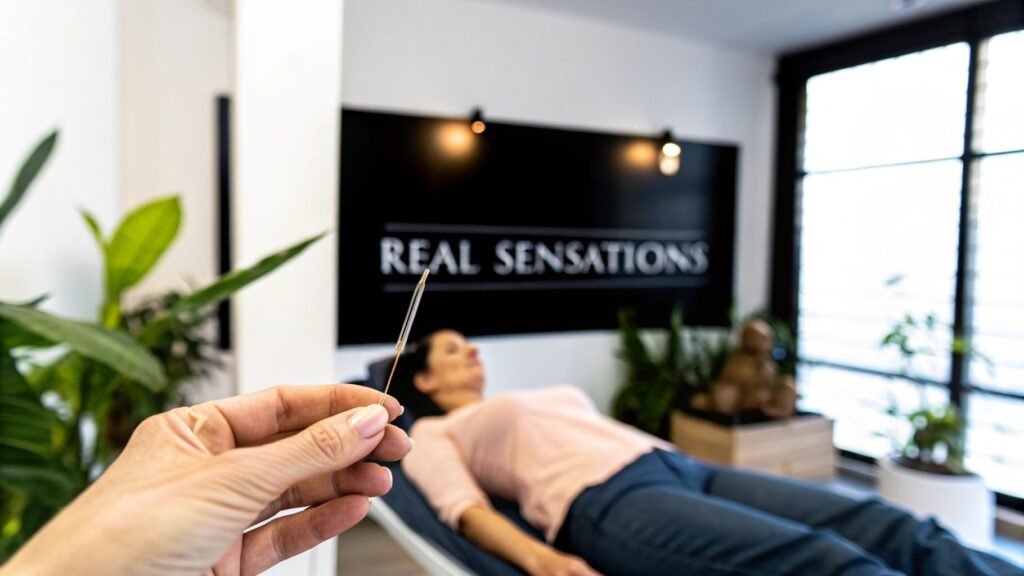
If you're wondering what does acupuncture feel like, you're not alone. Many first-timers imagine it will be like getting a shot at the doctor's office, but the reality is a world away from that. The experience is far more nuanced and, for most people, surprisingly relaxing.
Decoding the Sensation of an Acupuncture Needle

First things first: an acupuncture needle is nothing like the hollow, thick hypodermic needle used for injections. Acupuncture needles are solid, flexible, and incredibly fine—some are as thin as a single human hair. Their design allows them to part the skin's fibers rather than tearing them, which makes a huge difference in what you feel.
So, what happens when the needle goes in? Most people report one of a few things:
- A tiny pinch or prick, like a mosquito bite that disappears in a second.
- A feeling of light pressure or a gentle tap where the needle is placed.
- Often, nothing at all. It's quite common not to feel the initial insertion.
Any sharp feeling should be brief—lasting just a moment. If you ever feel a lingering sharp, stinging, or burning sensation, let your practitioner know right away. That’s not the goal.
The Feeling of De Qi
After the needle is set, your acupuncturist might gently rotate or move it to stimulate a unique sensation called de qi (pronounced "duh-chee"). This is a cornerstone of traditional acupuncture, indicating that the needle is engaging with your body's energy and starting its work.
De qi is best described as a deep, radiating feeling around the needle site. It’s not pain. Instead, patients often describe it as a dull ache, a sense of heaviness or warmth, or a mild tingling that spreads out from the point.
This sensation is actually a good sign! It signals that the body's natural healing processes are kicking into gear. For many people, feeling de qi is the turning point in the session where their body begins to shift into a state of deep relaxation.
A Quick Guide to Acupuncture Sensations
To give you a better idea, here’s a quick breakdown of the common sensations you might encounter and what they generally mean.
| Sensation | What It Feels Like | What It Typically Means |
|---|---|---|
| Slight Prick | A quick, mosquito-bite-like pinch at the moment of insertion. | The needle is passing through the very top layer of skin. |
| Dull Ache | A deep, heavy, or achy feeling around the needle. | A classic sign of de qi; the point is activated. |
| Warmth | A gentle, spreading warmth radiating from the needle. | Increased circulation and energy flow to the area. |
| Tingling | A mild, electric-like tingle, sometimes spreading along a line. | Stimulation of the body's energy pathways or nerves. |
| Pressure | A feeling of fullness or pressure at the insertion site. | The needle is in the correct location and stimulating the point. |
Remember, communication with your practitioner is key. They can adjust the treatment to ensure you remain comfortable throughout the entire session.
From Sensation to Relaxation
This isn't just anecdotal. Modern research backs up these patient experiences. A dull ache or tingling is frequently reported as a sign of effective treatment. For instance, a 2023 study revealed that even people new to acupuncture reported significant pain relief after feeling these characteristic sensations. You can explore the detailed patient experiences from this study on PLOS ONE.
A Timeline of Your First Acupuncture Session
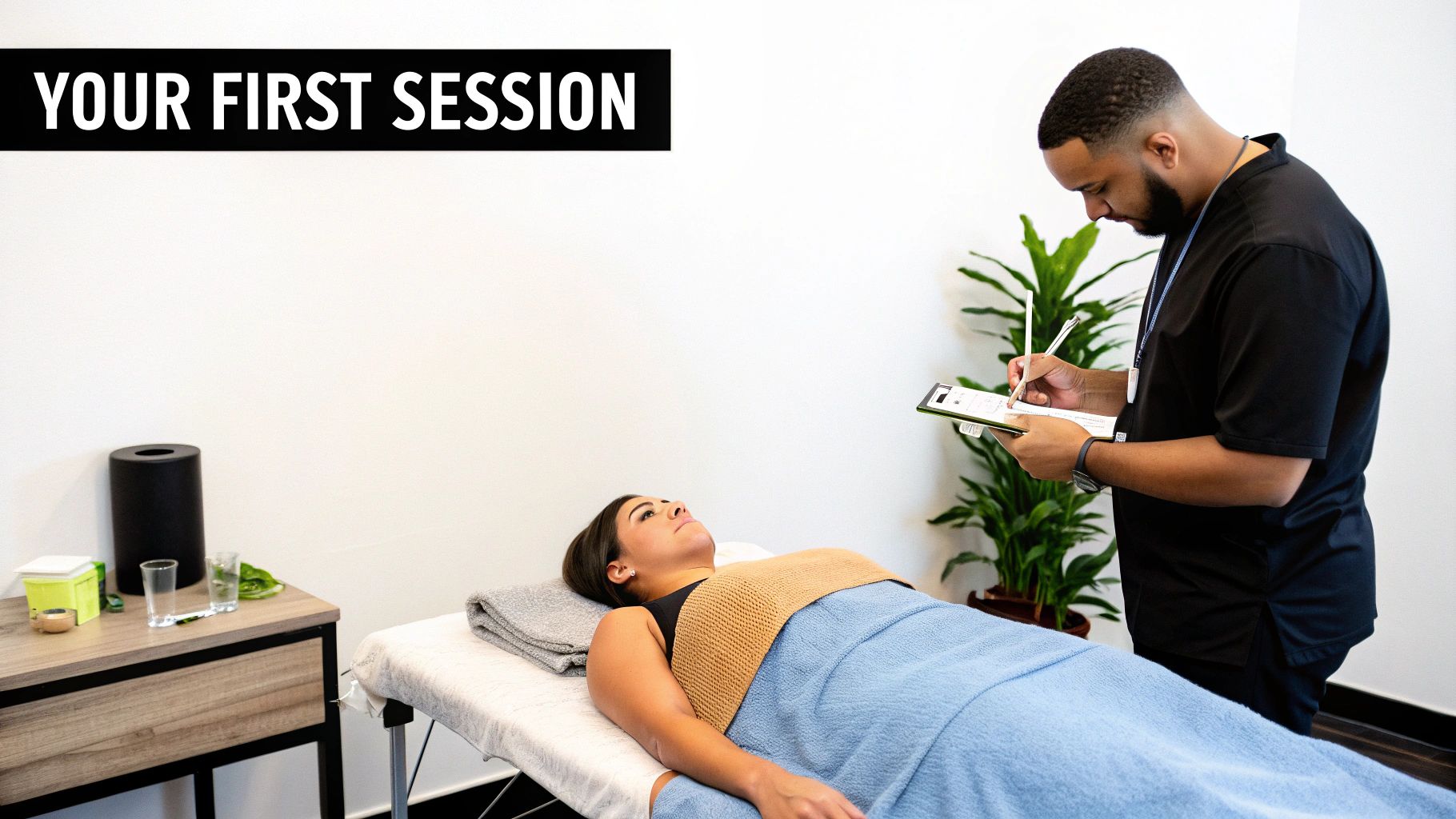
Walking into your first acupuncture appointment can feel a little mysterious. Knowing the typical flow of a session can turn any nerves you might have into simple curiosity. The whole experience unfolds in three distinct stages, each designed to guide you toward relaxation and healing.
It’s important to remember that the actual treatment starts the moment you walk in the door, not just when the first needle is placed.
Phase One: Before the Needles
Your first visit always kicks off with a detailed conversation. We'll sit down and talk through your health history, what's bothering you, and what you hope to achieve. This is more than just a chat; it's a deep dive into your body's unique patterns.
I might also use some classic diagnostic methods from Chinese Medicine, like looking at your tongue or feeling the quality of the pulse on both of your wrists. This comprehensive intake helps me build a complete picture of your health.
Once we have a plan, you'll get comfortable on the treatment table. We aim to create a truly calming space—think soft lighting, maybe some gentle music, and a warm lamp if you'd like. The last step before the treatment begins is simply swabbing the skin to make sure the points are clean.
Phase Two: During the Treatment
This is the part everyone asks about. As I gently insert the first sterile, single-use needle, you might feel a tiny, fleeting pinch, or honestly, nothing at all. It’s over in an instant.
What comes next is a sensation known as de qi (pronounced "duh-chee"). This is the signal that we've connected with the body's energy. It's often described as a dull ache, a feeling of warmth, or a gentle throb right at the needle site. Once all the needles are in place, the most important part of the session begins: you get to rest. This usually lasts for 15 to 30 minutes.
During this quiet rest period, the sensations of the needles often fade into the background. Many patients report entering a state of profound relaxation, often called an "acu-nap," where the mind becomes still and the body feels heavy and deeply relaxed.
This tranquil state is where the real work happens. Your nervous system shifts from "fight-or-flight" into "rest-and-digest," allowing your body to release its own natural pain-relievers and start rebalancing itself. For a closer look at what happens during this part of the session, our guide on what to expect during your acupuncture visit offers more detail.
Phase Three: After the Session Ends
When your rest time is up, I’ll return and gently remove the needles. This part is quick and painless—most people barely feel a thing as they come out.
Immediately after, patients often report a profound sense of well-being. It’s common to feel:
- A feeling of lightness or mental clarity, as if a weight has been lifted.
- Deep relaxation that can linger for hours or even the rest of the day.
- A subtle boost in energy or a more grounded, centered feeling.
- An immediate reduction in the pain or symptoms you came in with.
We often call this the "acupuncture afterglow." It's that pleasant, restorative feeling that tells you your body has responded and a positive shift is underway.
One of the first questions on everyone's mind is, "Will it hurt?" It's a completely fair question. The key, though, is learning to tell the difference between actual pain and a therapeutic sensation. Acupuncture should never be painful; a sharp or stinging feeling is simply a sign that a needle needs a slight adjustment.
So, what are you supposed to feel? We’re looking for a sensation called de qi, a sign that the treatment is hitting the right spot and doing its job. It often feels like a dull ache, a sense of warmth or heaviness, or maybe a gentle tingle that spreads from the needle. It's not really pain—it's more like a conversation your body is having with the needle.
It Feels Different in Different Spots, and That's Okay
You'll quickly notice that the feeling changes depending on where the needles are. That's totally normal. Some parts of the body are just more sensitive than others.
- Hands and Feet: These spots have a lot more nerve endings and less padding, so you might feel a more distinct little prick when the needle first goes in. It should fade almost immediately.
- Fleshy Areas: Think about your back, thighs, or stomach. Here, the sensation is usually deeper, duller, or heavier.
Try to think of it this way: instead of bracing for pain, see these sensations as positive feedback. It’s a clear signal that your body's own healing systems are kicking into gear. We're just giving it a gentle, precise nudge in the right direction.
The most important thing is to keep talking to your practitioner. If any feeling ever crosses the line from a dull ache into something genuinely uncomfortable, let them know right away. A tiny adjustment is usually all it takes to make you comfortable again, ensuring your session stays relaxing and restorative. Understanding what to expect when managing chronic pain with acupuncture can make all the difference in feeling prepared.
Acupuncture’s Excellent Safety Record
You can also feel confident knowing that acupuncture has an incredible safety profile. Decades of research and real-world clinical data show that the sensations are almost always mild and serious side effects are extremely rare. This track record is a big reason why it's become so popular.
Here in the United States, acupuncture use has more than doubled in the last two decades, with over 7.3 million adults trying it in 2022. A whopping 72% of them were looking for help with pain.
The results speak for themselves. In one major Medicaid pilot study for patients with chronic pain, adding acupuncture led to an 86% drop in opioid prescriptions. It’s a powerful testament to how readily patients embrace it as a safe and effective option. If you want to dig deeper into the research, you can learn about the findings from the National Center for Complementary and Integrative Health.
How Different Acupuncture Techniques Can Feel
While the feeling of a classic acupuncture needle is quite subtle, the practice is much broader than just needles. It includes several related therapies, and each one has its own unique sensation. Your practitioner might suggest adding one of these to enhance your treatment, so knowing what to expect can help you relax into the experience. The main thing to remember is that not all treatments feel the same—the sensations change quite a bit depending on the specific method we're using.
This chart is a great visual guide for telling the difference between the intended, therapeutic feelings of acupuncture and sensations that mean something needs adjusting.

The key takeaway here is pretty simple: sensations like warmth, a dull ache, or tingling are all productive signs. On the other hand, sharp or stinging pain is not the goal, and you should always let your practitioner know right away if you feel that.
Electro-Acupuncture: A Gentle Pulse
Electro-acupuncture is a more modern approach where we pass a small, gentle electrical current between two needles. I know that sounds a bit intense, but it's really not! Instead of a jolt, you'll feel a mild, rhythmic tapping, a light pulsing, or a vibrating sensation right at the needle site.
The intensity is always adjusted to a comfortable level for you. We often use this technique to boost pain relief and bring down inflammation. It definitely feels different from standard needling—many people describe it as more "active," like the points are getting continuous, gentle attention—but it should never be uncomfortable.
Cupping: A Feeling of Suction and Release
You've probably seen the distinctive circular marks cupping can leave, but what does it actually feel like? Cupping therapy involves placing glass or silicone cups on the skin to create suction. This feels like a firm but gentle pulling on your skin and muscles. Most people find this sensation deeply relaxing, almost like a reverse deep-tissue massage where the pressure pulls outward instead of pressing inward.
As the cups are left in place or moved around, you might feel a pleasant warmth and a sense of release as muscle tension begins to unwind. That initial tight pulling sensation usually fades after a minute or two, replaced by a feeling of openness and relief in the area. It's also worth noting that the difference between acupuncture and dry needling also comes down to very different sensations and therapeutic goals.
Moxibustion: A Deep, Penetrating Warmth
Moxibustion involves an herb called mugwort, which is dried and then burned near the skin or on the end of a needle. The goal is to introduce a therapeutic heat into the body. You won't feel any burning at all. Instead, the sensation is a pleasant, deep, and penetrating warmth that radiates from the point.
This gentle heat is incredibly soothing. It's fantastic for improving circulation, easing stiff joints, and promoting deep relaxation. Think of it like a tiny, focused heating pad working on a very specific point to provide targeted relief.
To make it even clearer, here’s a quick breakdown of what you can expect from each of these common therapies.
Comparing Sensations Across Different Therapies
| Technique | Primary Sensation | Commonly Used For |
|---|---|---|
| Manual Acupuncture | A subtle prick, then a dull ache, warmth, or tingling. | General wellness, pain, stress, digestive issues. |
| Electro-Acupuncture | A gentle, rhythmic pulsing, tapping, or vibrating. | Chronic pain, nerve issues, muscle spasms. |
| Cupping | A tight pulling or suction, followed by release and warmth. | Muscle tension, pain, inflammation, respiratory conditions. |
| Moxibustion | A deep, penetrating, and soothing warmth. | Poor circulation, digestive weakness, arthritis, menstrual pain. |
Knowing about these variations helps you feel more prepared for what the different parts of your treatment might feel like. Each technique offers a distinct sensory experience, all designed to support your body's healing process in a comfortable and effective way.
What to Expect After Your Session Ends
The work isn't over just because the needles are out. Once you’ve had that quiet rest on the table and your session wraps up, your body is just getting started processing the treatment. Knowing what’s normal to feel afterward helps you lean into the healing process and get the most out of every visit.
Many people leave the clinic floating on a cloud. We often call this the "acupuncture afterglow," and it’s one of the best parts of the experience.
You might feel it as:
- Deep Relaxation: A profound sense of calm that can stick with you for hours, leaving you feeling grounded and at ease.
- Mental Clarity: Some people say it's like a mental fog has lifted. Your thoughts feel sharper and more focused.
- Increased Energy: While some feel ready for a nap, others get a gentle, sustained boost of energy that feels natural, not buzzy.
- Pain Relief: You may notice right away that the pain or discomfort you came in for has already started to ease up.
Potential Side Effects and Sensations
While feeling great is the goal, it's also completely normal to have a few minor, temporary reactions as your body adjusts. Think of it as your system recalibrating. These feelings are almost always mild and fade within a day or two.
Common post-treatment sensations include:
- Lingering Relaxation or Drowsiness: This is a fantastic sign that your nervous system has shifted into its "rest and digest" mode, which is where real healing happens.
- Minor Soreness: You might feel a dull ache at a few of the needle points, much like the feeling you get in your muscles a day after a good workout.
- Light Bruising: Occasionally, a tiny, harmless bruise might pop up where a needle was. It’s nothing to worry about and will disappear quickly.
These sensations are simply part of your body's response and are often seen as positive signs that the treatment is taking hold. In fact, what you feel is so important that it's become a key measure of success in clinical research. The sensations during and after treatment—things like heaviness, tingling, or warmth—are central to understanding a treatment's effectiveness. Today, a staggering 81% of clinical trials include these patient-reported feelings to gauge how well the acupuncture is working. You can discover more about how patient sensations are tracked in research.
Maximizing Your Post-Treatment Benefits
A little self-care after your appointment can go a long way in helping your body integrate the work we just did and extend the benefits.
After your session, try to keep your schedule light for the rest of the day. Think of it as giving the subtle adjustments we made time to settle in without being disturbed.
Here are a few simple tips to follow:
- Stay Hydrated: Drink plenty of water. It helps your body continue the clearing-out process that the session started.
- Avoid Strenuous Activity: Give the gym a miss for the rest of the day. A gentle walk is perfect, but anything that puts major stress on your body can wait.
- Eat a Nourishing Meal: Support your body’s healing with a light, healthy meal. It gives your system the fuel it needs without weighing it down.
Common Questions About How Acupuncture Feels
https://www.youtube.com/embed/3WMZUi_4eF4
Even after understanding the basics, it's completely normal to have a few questions buzzing in your mind before your first appointment. Let's walk through some of the most common ones. Answering these can help turn any lingering nervousness into genuine curiosity and confidence, so you can walk into your session feeling relaxed and ready.
Will I Feel the Needles the Whole Time They Are In?
This is probably the number one question people have, and the good news is, the answer is almost always no. Once the needles are in place and we've achieved that initial de qi sensation, your awareness of them will likely just melt away.
Most people find they become so deeply relaxed that they forget the needles are even there. It’s very common to drift into a light, restorative sleep—something we fondly call an "acu-nap." The main thing you'll probably feel during this quiet time is a profound sense of calm. If any needle ever feels persistently uncomfortable, just say the word. A tiny adjustment is usually all it takes to make it perfect.
Does Acupuncture Feel Different on Various Parts of the Body?
Absolutely, and that's a normal part of the process. The sensations you feel can change quite a bit depending on where the acupuncture point is located. Think about it—the anatomy and nerve density are different all over your body.
Here’s what you might notice:
- Fleshy Areas: In spots with more muscle and tissue, like your back, hips, or stomach, the de qi sensation often feels like a dull, heavy, or deep ache. It's a very grounding feeling.
- Hands and Feet: These areas are packed with nerve endings and have much less padding. Here, you might feel a sharper, more distinct prickle or even a quick, electric-like zing when the needle first goes in.
This variety is all by design. Your practitioner selects specific points for their therapeutic effects, and the different feelings are just a sign that we're successfully stimulating those unique spots.
Remember, the goal is always a therapeutic sensation, not sharp pain. A dull ache is productive; a sharp sting is a sign that a needle needs to be adjusted for your comfort.
What if I Have a Fear of Needles or Low Pain Tolerance?
A fear of needles is incredibly common, so you are not alone. Experienced acupuncturists are very used to helping anxious patients feel safe and at ease. The most important thing you can do is be open and honest about your fears before we even start.
We have plenty of ways to make sure you have a good experience:
- We can use the absolute thinnest needles available.
- We can start with just a few points to let you get used to the feeling.
- We can even begin with non-needle techniques like acupressure to help you relax first.
- We will talk you through every single step, so nothing comes as a surprise.
So many people who start out nervous about needles are genuinely shocked by how gentle and relaxing acupuncture really is. And if you're curious about other traditional methods, you might want to learn more about treatments like cupping therapy, which provides a completely different sensory experience without any needles at all.
Is It Possible to Feel a Bit Worse Before Feeling Better?
While it’s not the norm, a small number of people might notice a temporary, mild flare-up of their symptoms for a day or so after their first treatment. In the world of traditional medicine, this is often seen as a good sign—it means your body's healing systems have been powerfully activated.
You can think of it like stirring up a pond to clear out the sediment. This brief intensification is almost always followed by a significant improvement. That said, it's important to know that the vast majority of people feel better right away, reporting immediate pain relief, a wave of calm, or a welcome boost in energy after their very first session.
Ready to discover how acupuncture can help you find balance and relief? At Eric Tsai Acupuncture and Herbs, we combine traditional wisdom with modern understanding to create a treatment plan that feels right for you. Book your appointment online or call us to start your journey toward better health today.