

Chronic pain is a complicated beast. If you've been trying to tackle it with just one type of treatment, you know how frustrating it can be when you don't get the relief you need. This is where multi specialty pain management comes in.
Think of it as assembling a dedicated team of medical experts—physicians, physical therapists, acupuncturists, and even psychologists—all focused on a single goal: creating one unified treatment plan just for you. It’s a philosophy that moves beyond chasing symptoms and gets to the real, interconnected roots of your pain.
Why A Team Approach Is Better For Pain
Let’s use an analogy. Imagine you want to build a custom home. You could hire just a carpenter and hope they figure out the plumbing and electrical work, but that’s a huge gamble. The smarter move is to bring in an architect, an engineer, a plumber, and an electrician who all work from the same blueprint. The result? A home that’s strong, functional, and built to last.
Managing chronic pain is no different.
When you see one specialist at a time—a single-discipline approach—care can feel disjointed. Your primary doctor might give you medication, a surgeon could suggest an operation, and a physical therapist might recommend exercises. While each professional is a true expert in their field, they’re often working in silos. That leaves you stuck in the middle, trying to connect the dots between their different recommendations.
A multi specialty pain management model gets rid of that fragmentation. It ensures every specialist is on the same page, collaborating on a shared strategy for your relief and recovery. This team-based method has become the modern gold standard for getting a handle on persistent pain.
To better illustrate the difference, here's a quick comparison of the two models.
Single-Discipline vs. Multi Specialty Pain Management
| Feature | Single-Discipline Approach | Multi Specialty Approach |
|---|---|---|
| Philosophy | Treats a specific symptom or condition in isolation. | Addresses the whole person—physical, mental, and emotional aspects of pain. |
| Care Coordination | Fragmented; the patient is often responsible for coordinating between specialists. | Integrated; the team communicates and collaborates on a single, unified plan. |
| Treatment Scope | Limited to one area of expertise (e.g., medication, surgery, or physical therapy). | Comprehensive; combines multiple therapies (medical, rehabilitative, psychological, complementary). |
| Patient Role | Often a passive recipient of treatment. | An active partner in developing and following the treatment plan. |
| Potential Outcome | May provide temporary relief but can miss underlying causes. | Aims for long-term, sustainable relief and improved quality of life. |
As you can see, the integrated approach is designed to be more thorough and patient-centered, moving beyond temporary fixes to create lasting change.
Building Your Personalized Roadmap To Recovery
This collaborative model is built on a simple truth: pain isn't just a physical sensation. It has emotional, psychological, and even social dimensions. No single practitioner, no matter how skilled, can effectively address all of these layers on their own.
A multi specialty team, on the other hand, is perfectly equipped to build a plan that tackles every facet of your condition. For instance:
- Physical Rehabilitation: A physical therapist can guide you through exercises to rebuild strength and restore mobility safely.
- Medical Interventions: A pain management physician might manage medications or perform targeted procedures like nerve blocks for more immediate relief.
- Psychological Support: A psychologist can provide you with powerful coping strategies to handle the mental and emotional strain of living with chronic pain.
- Complementary Therapies: An acupuncturist can work on inflammation and neurological pathways to calm pain signals and kickstart your body's natural healing processes. Our clinic’s holistic approach to pain management is deeply rooted in this exact philosophy.
The Growing Need For Integrated Solutions
The shift toward this kind of team-based care isn't just a trend; it's a necessary evolution in medicine. We're finally recognizing how complex chronic conditions truly are. The demand for better solutions is huge, with the global chronic pain management market valued at around $78.79 billion and projected to climb to $117.03 billion by 2029. This boom is fueled by the shortcomings of older, one-track treatment methods and the rising number of people living with conditions that cause persistent pain. You can read more about what is driving global chronic pain market growth on openpr.com.
By bringing a diverse group of experts together under one coordinated plan, multi specialty pain management offers a more complete, supportive, and sustainable path to feeling better. It’s not about finding a single magic bullet. It’s about building a robust, multi-layered strategy that puts you back in control and helps you reclaim your life from pain.
Meet Your Integrated Pain Management Team
Think of a multi-specialty pain management program as having an expert pit crew dedicated to your well-being. Each professional has a specific, highly skilled role, but they all work together from the same playbook—your personal care plan. This approach is about much more than just chasing symptoms; it's about assembling a team that understands the complete picture of your pain.
Instead of you having to juggle appointments with specialists who don't talk to each other, this model puts all the experts in communication. Their combined insight creates a synergy where one treatment makes another more effective, leading to stronger, more lasting relief. Let's introduce the key players you'll typically find on an integrated team.
The Pain Management Physician
The pain management physician is essentially the team's quarterback. This doctor, who is often an anesthesiologist or physiatrist, has specialized training in diagnosing and treating complex pain conditions. They start by conducting a deep dive to get to the root cause of what's hurting you.
Their role includes:
- Directing the overall strategy: They coordinate with every other specialist to make sure all therapies are pulling in the same direction toward your goals.
- Administering medical procedures: This might involve nerve blocks, epidural injections, or other precise interventions aimed at providing significant, targeted pain relief.
- Handling medications: They are responsible for prescribing and monitoring medications to control pain and inflammation, which in turn helps you participate more fully in other therapies.
The Physical Therapist
The physical therapist is your movement specialist, focused on rebuilding your body's strength, flexibility, and overall function. Pain has a nasty habit of making us inactive, which only leads to weaker muscles and more stiffness—a truly vicious cycle. The physical therapist’s job is to help you break free.
They design a custom exercise program to help you get moving again safely and rebuild confidence in your body. For instance, if a physician’s nerve block takes your low back pain from a 7/10 down to a 3/10, the physical therapist can then introduce core-strengthening exercises that were previously impossible, building a solid foundation to prevent future problems.
The Psychologist
Chronic pain isn't just a physical battle; it takes a huge mental and emotional toll. A psychologist or behavioral health specialist is there to address this crucial side of your health. They equip you with practical tools to manage the stress, anxiety, and depression that so often come with persistent pain.
Using methods like Cognitive Behavioral Therapy (CBT), they help you change the way you think about your pain. This mental shift can profoundly alter your perception of pain, making your physical treatments far more successful and dramatically improving your quality of life.
The Acupuncturist
A licensed acupuncturist, such as Dr. Eric Tsai, brings a unique and incredibly effective perspective to the team. Acupuncture, rooted in Traditional Chinese Medicine and backed by modern science, works by influencing specific neurological pathways and dialing down inflammation. For many patients, it’s a game-changer for finding relief without a heavy reliance on medications.
This infographic shows how pain management must address interconnected physical, psychological, and emotional factors.
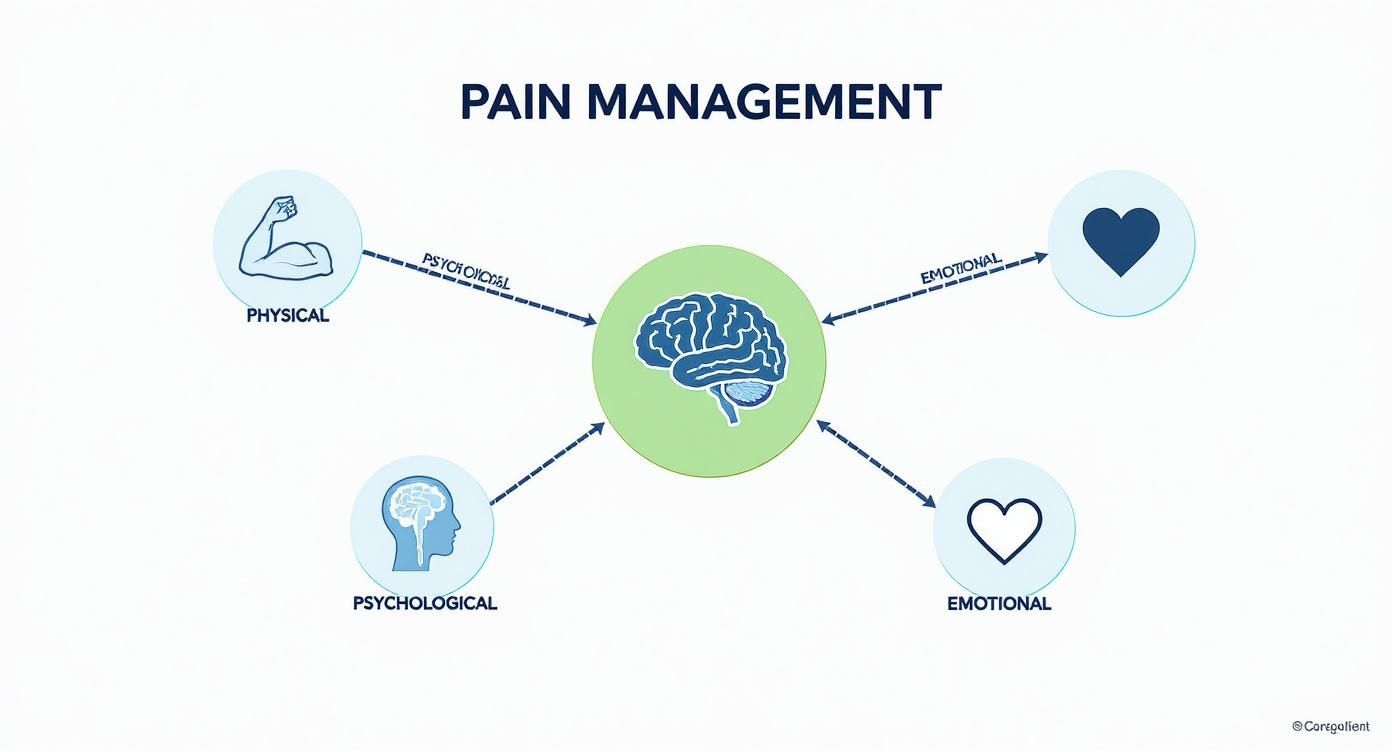
The image drives home the point that a truly effective plan can't just focus on one area. It demands a coordinated effort across all three domains.
These experts don't operate on their own islands. A patient might see an acupuncturist to calm nerve pain, which then makes it easier for the physical therapist to make progress. At the same time, a psychologist helps that patient build the mental resilience to handle the ups and downs of recovery. To see how this all comes together in practice, you can learn more about our integrated pain management team. This synergy is the secret sauce of a great program, where each expert's contribution amplifies the power of the entire plan.
Core Treatments in a Cohesive Pain Program
Think of a comprehensive pain management program like a master carpenter's toolbox. You wouldn't build a house with just a hammer, and you can't effectively manage complex pain with just one therapy. The real magic happens when different tools are used together, each for its specific purpose. The goal isn't just to find a single "fix" but to combine treatments that address pain from every angle—physical, neurological, and emotional.
This layered approach is where we see the best results. Let's break down the key components and see how they fit together to create a personalized roadmap to feeling better.
Interventional and Medical Procedures
When pain is sharp, constant, and overwhelming, the first order of business is often to turn down the volume. This is where a pain management physician comes in, using highly targeted procedures to provide immediate relief. Think of these as a circuit breaker for your pain signals.
Commonly used interventions include:
- Nerve Blocks: A precise injection of anesthetic medication to temporarily "switch off" the specific nerves sending pain signals to your brain.
- Epidural Steroid Injections: Delivers powerful anti-inflammatory medication right to the source of the problem, often used for spinal conditions like sciatica or herniated discs.
- Medication Management: The strategic and careful prescribing of medications to control pain and inflammation, always with an eye on avoiding dependency.
These procedures can be life-changing, but they're rarely the whole story. Their true power is in creating a window of opportunity, making your body receptive to the rehabilitative work that comes next.
Physical and Occupational Rehabilitation
With the initial, intense pain under control, the focus shifts to rebuilding. This is the domain of physical therapists (PTs) and occupational therapists (OTs), who help you restore function, regain strength, and prevent future injuries. They’re not just treating the pain; they’re helping you reclaim your life.
A PT will design exercises to improve your strength, flexibility, and mobility. Meanwhile, an OT helps you re-learn how to perform daily tasks—whether it's sitting at your desk or lifting groceries—in a way that doesn't trigger your pain. For example, once a nerve block has eased your sciatica, a PT can finally guide you through the core-strengthening exercises that were impossible before, building a stronger foundation to prevent a recurrence.
Psychological and Behavioral Support
Anyone who has lived with chronic pain knows it's more than just a physical sensation. It affects your mood, your sleep, and your relationships. Overlooking this emotional toll is a huge mistake and a key reason why many treatment plans fall short.
Therapies like Cognitive Behavioral Therapy (CBT) and mindfulness aren’t about pretending the pain doesn't exist. They're about changing your relationship with the pain. You learn techniques to break the vicious cycle where pain causes stress, and stress, in turn, makes the pain even worse.
This mental and emotional support makes every other treatment more effective. When you're less afraid of movement, you'll get far more out of physical therapy. When your stress is managed, your body’s own inflammatory response often quiets down.
Complementary and Integrative Therapies
Finally, we have the therapies that round out the entire program, often addressing the subtle imbalances that conventional medicine might miss. Here at Eric Tsai Acupuncture & Herbs, modalities like acupuncture, custom herbal formulas, cupping, and tuina massage are essential parts of the puzzle. They are incredibly effective at calming the nervous system, reducing inflammation, and stimulating the body's innate healing abilities.
An integrated clinic will often include various natural remedies for pain alongside conventional treatments. For instance, consistent acupuncture can often help a patient reduce their reliance on powerful pain medications, offering a much safer strategy for long-term health. This is true collaboration—a physician manages necessary medications while an acupuncturist works to lessen the need for them. To see how these can be woven together, take a look at our guide on chronic pain treatment options.
Despite the power of this balanced approach, the wider pain management market is still heavily reliant on pharmaceuticals. Valued at around $81.92 billion, the market is projected to hit $102.53 billion by 2030, with drugs making up nearly 70% of that revenue. This data underscores why it's so important to find a clinic that intentionally integrates non-drug therapies for a more sustainable and holistic path to recovery.
Navigating Your Patient Journey to Relief
https://www.youtube.com/embed/Xaqe1uWGd3k
Deciding to visit a multi-specialty pain management clinic is a significant first step, especially when you've been dealing with pain on your own for a long time. The great thing is, you’re not stepping into a confusing maze of appointments. You're entering a well-defined, collaborative process designed to give you clarity and support from day one. It's a clear path forward, with each stage building on the one before.
To bring this to life, let’s walk through the experience of a patient we’ll call "David." He’s a 45-year-old who has been battling chronic knee pain for years, a lingering reminder of an old sports injury. The pain made walking a chore, wrecked his sleep, and kept him on the sidelines of family life. After trying various treatments that only masked the problem, he was ready for a truly integrated approach.
The Comprehensive Initial Assessment
David's journey didn't start with a prescription pad. It started with a thorough, holistic assessment that brought multiple experts to the table. This wasn't just another doctor's visit; it was a deep dive into his condition.
His initial consultation involved a pain physician who carefully reviewed his entire medical history. Then, a physical therapist analyzed his gait and how he moved.
He also met with an acupuncturist, who looked at his body’s energy pathways and inflammation patterns through the lens of Traditional Chinese Medicine. Each specialist saw his pain from a different angle, helping to uncover factors that had been missed before. This team-based diagnostic phase is the bedrock of the entire process—it ensures we see you, not just your symptoms.
Collaborative Planning for a Unified Strategy
Once the assessments were done, the real magic began: creating a unified care plan. This is the moment a multi-specialty approach truly shines. The entire team—the physician, physical therapist, and acupuncturist—came together to discuss David's case. They pooled their findings to craft a single, cohesive strategy.
They discovered his knee pain wasn't just one thing. It was a combination of mechanical instability from the old injury, deep-seated chronic inflammation, and even nerve sensitivity that had developed over time.
The plan they built was, by design, multifaceted:
- Medical Intervention: The physician suggested a precisely targeted anti-inflammatory injection to give David immediate relief and help break the cycle of pain and inflammation.
- Physical Therapy: The physical therapist created a custom exercise program focused on strengthening the muscles around the knee to improve its stability and function.
- Acupuncture: The acupuncturist laid out a schedule of sessions aimed at reducing inflammation, calming overactive nerve signals, and kickstarting the body's natural healing processes in the joint. You can learn more about what to expect from acupuncture in our detailed guide.
David wasn't just getting three different treatments; he was getting one coordinated solution where every part supported the others.
Active Treatment and Progress Reviews
With his roadmap in hand, David moved into the active treatment phase. His appointments were strategically coordinated to build on each other. For instance, his acupuncture sessions were often scheduled right before physical therapy, which helped reduce his pain and allowed him to get more out of his exercises.
The key to this phase is continuous communication and adaptation. The team held regular, brief check-ins to monitor David’s progress. After a few weeks, they noticed his inflammation was down, but his mobility was still limited by fear of re-injury.
This is where the plan evolved. Seeing his hesitation, they adjusted the strategy to include sessions with a behavioral health specialist. This helped him rebuild confidence in his knee and work through the anxiety he felt about movement. This ability to pivot and fine-tune the plan in real-time is what helps patients break through plateaus and get lasting results.
David’s story shows how a structured, team-based journey creates both clarity and momentum. The entire process is designed to empower you with the tools for long-term self-management, ensuring you feel supported and informed every step of the way.
How to Choose the Right Pain Management Clinic
Finding the right partner for your health journey is one of the most important decisions you'll make. When it comes to multi-specialty pain management, not all clinics are created equal. Some operate as truly integrated teams working from a shared playbook, while others are just a collection of specialists practicing under the same roof with very little collaboration.

To find a high-quality center that’s the right fit, you have to know what to look for and what questions to ask. This is the only way to be sure you're choosing a clinic that offers a genuinely cohesive approach to your recovery.
Evaluating a Clinic's Philosophy
Before you even get into specific treatments, start by getting a feel for the clinic's core philosophy. A genuinely patient-centered practice will put a heavy emphasis on collaboration—not just among its own specialists, but with you. You should feel like an active partner in your care, not just someone receiving services.
Pay close attention during your first consultation. How do they describe their process? Do they talk about a team-based approach and personalized care plans? Or does it feel more like you’re being shuffled down a standard, one-size-fits-all treatment path?
The best clinics view pain through a wide-angle lens, considering the physical, emotional, and psychological factors that contribute to your condition. Their goal should be to empower you with long-term solutions, not just to provide temporary fixes.
This patient-first mindset is the bedrock of effective care and a clear sign of a clinic’s quality and commitment.
Key Questions to Ask During a Consultation
To tell the difference between a truly integrated center and one that just looks good on paper, you need to come prepared with some specific questions. That first meeting is your chance to really vet the clinic and see if it aligns with what you need.
Here’s a checklist to help guide that conversation:
- How do the specialists on the team communicate about patient care? You're listening for answers that include regular team meetings, shared electronic health records, and a formal process for creating and adjusting treatment plans together.
- What range of in-house specialists do you have? A strong clinic will have a diverse team, like pain physicians, physical therapists, acupuncturists, and behavioral health experts, all available on-site.
- How is a new patient's treatment plan created? The ideal response describes a comprehensive initial assessment where multiple specialists give their input, leading to a single, unified plan.
- How do you measure a patient's progress? They should be able to explain how they track outcomes beyond just pain scores—things like improvements in function, quality of life, and emotional well-being.
- How will you coordinate with my primary care physician? A good clinic sees itself as part of your broader healthcare network and will proactively communicate with your other doctors.
Finding the right complementary services, like acupuncture, is also crucial. For those in the Chino, CA area, it's vital to understand how a specialist like Eric Tsai Acupuncture & Herbs can fit into a broader care plan, ensuring every piece of your treatment is working in concert.
The need for these centers is growing fast. Low back pain alone affected an estimated 619 million people and is projected to hit 843 million by 2050, making integrated clinics more essential than ever. You can discover more insights about the growth of the pain management market on towardshealthcare.com. Choosing wisely is the first step toward getting the coordinated, effective care you deserve.
Common Questions About Integrated Pain Care
Even after understanding the benefits of a multi specialty pain management model, it's natural to have some practical questions. Let's tackle some of the most common concerns we hear from patients, so you can feel confident about taking the next step toward relief.
How Is This Different From Just Seeing Multiple Doctors?
This is a fantastic question because it gets right to the heart of what makes this approach special. The difference is integration versus fragmentation.
When you see multiple, separate doctors, you’re often left playing coordinator. You have to juggle different appointments, try to make sense of conflicting advice, and worry about whether one treatment might interfere with another. It’s a lot of work, and it can be incredibly inefficient.
In an integrated model, that burden is lifted. The specialists work as a single, cohesive team. They're in constant communication, sharing notes and insights to build one unified treatment plan just for you. Think of it like a well-rehearsed orchestra creating a beautiful symphony, rather than a group of solo musicians all playing different tunes at the same time. The result is a powerful, synergistic effect that you just can't get from isolated appointments.
Is This Approach Only for Severe, "Last-Resort" Pain?
Not at all. While this model is a game-changer for people with complex, chronic conditions that haven’t responded to anything else, its value extends far beyond that. An integrated approach is a smart choice for anyone whose pain isn't getting better with a single type of treatment.
It’s about being proactive, not just reactive. By bringing a multi-specialty team in early, you can address all the different angles of pain—the physical, the neurological, and the emotional—right from the start. This comprehensive strategy can often stop acute pain from becoming a long-term, debilitating problem.
The goal is to offer a complete solution that gets to the root causes of pain, not just mask the symptoms. That makes it a powerful option for everything from recent injuries to nagging issues that have lingered for years.
Will My Insurance Cover Multi-Specialty Pain Management?
This is one of the most important practical questions. Insurance coverage can vary quite a bit based on your specific plan, so it's wise to do a little homework upfront.
Generally, you can expect core medical services to be covered. These usually include:
- Physician consultations with the pain management doctor.
- Interventional procedures, such as nerve blocks or injections.
- Physical therapy sessions that are prescribed as part of your recovery.
Where it can get a bit more varied is with complementary and behavioral therapies. Services like acupuncture, massage, or mental health counseling might have different rules—perhaps a cap on the number of visits per year or a requirement for a specific referral. Before you begin, the best thing to do is call both the clinic and your insurance provider. A good clinic will often help you with this, verifying your benefits so you have a clear picture of any out-of-pocket costs.
How Long Does an Integrated Pain Program Typically Last?
There really is no one-size-fits-all answer here, because the entire program is built around you—your condition, your goals, and how you progress. It’s not a rigid schedule; it’s an adaptive plan that evolves as you heal.
Someone with a more recent injury might only need an intensive program for a few weeks or months. On the other hand, a person dealing with a deeply rooted chronic pain condition may work with the team over a longer period, with the intensity of treatments changing as they improve.
The true goal of a multi specialty pain management program isn't endless treatment. It's empowerment. The team works to give you significant relief while also teaching you the skills and strategies to manage your health independently in the long run. The program is successful when you feel confident and equipped to maintain your progress and live your life fully.
At Eric Tsai Acupuncture & Herbs, we believe in this kind of collaborative and personal approach, blending the time-tested wisdom of Traditional Chinese Medicine with modern healthcare insights. If you're in the Chino, CA area and ready to explore a path to lasting wellness, we invite you to schedule a consultation. You can learn more at https://drerictsai.com.