
When you're dealing with persistent pain, it's easy to get caught in a cycle of just trying to make the hurt stop. But what if we looked at pain differently? A holistic approach to pain management does exactly that. It’s a philosophy that sees you as a whole person—mind, body, and environment—not just a collection of symptoms.
Instead of only masking the pain with medication, the goal is to dig deeper and understand why the pain is happening in the first place. This allows us to address the root cause for relief that actually lasts.
Moving Beyond Medication for Chronic Pain
For millions of people, chronic pain—that nagging lower back ache, the recurring headache, or those stiff, achy joints—is a constant companion. The typical response is often a prescription, which can certainly provide temporary relief.
But think of it this way: relying solely on medication is like putting a piece of tape over a warning light on your car's dashboard. Sure, the annoying light is gone, but the engine problem that triggered it is still there, unaddressed.
This is where the holistic perspective offers such a profound shift. It views your body as a deeply interconnected system, not just a set of isolated parts. From this viewpoint, pain isn't just a localized issue; it’s a signal that something is out of balance within the entire system.
A Deeper Look at the Causes
A practitioner with a holistic mindset will look beyond the specific area of pain to investigate what might be causing it. True, sustainable healing requires understanding the whole picture.
Factors we often investigate include:
- Biomechanical Imbalances: Things like poor posture or repetitive movements that put a constant strain on your muscles and joints.
- Chronic Inflammation: This is often fueled by diet, high stress levels, or other underlying health conditions.
- Emotional and Mental Stress: It’s no secret that stress takes a physical toll. High-stress levels can directly lead to muscle tension and make you more sensitive to pain.
- Nutritional Deficiencies: A simple lack of essential vitamins and minerals can seriously impact everything from nerve function to your body's ability to repair tissue.
This wider, more integrated view is why so many people are seeking out holistic care. In fact, the global market for chronic pain management was valued at around $78.79 billion and is expected to climb to $117.03 billion by 2029. This growth is largely driven by a shift away from medication-only models toward more comprehensive, integrative therapies.
A holistic approach doesn't just ask, "What can I take to stop this pain?" Instead, it asks, "Why is my body sending this pain signal?" This one question changes everything. It shifts the focus from temporary fixes to creating sustainable, long-term wellness.
To give you a clearer picture, let's break down the core differences between the conventional and holistic philosophies.
Holistic vs Conventional Pain Management At a Glance
This table offers a quick comparison to highlight the fundamental differences in how each approach views and treats pain.
| Aspect | Conventional Approach | Holistic Approach |
|---|---|---|
| Primary Focus | Symptom management. The main goal is to reduce or eliminate the pain signal. | Root cause resolution. The goal is to identify and correct the underlying imbalance causing the pain. |
| Treatment Model | Often relies on medication (e.g., painkillers, anti-inflammatories) or surgery. | Utilizes multiple modalities like acupuncture, nutrition, herbal medicine, and manual therapy. |
| Body Perspective | Tends to view the body as a collection of separate parts; pain is a localized problem. | Views the body as an interconnected system; pain is a signal of a systemic issue. |
| Patient Role | The patient is often a passive recipient of treatment. | The patient is an active partner in their healing process. |
Seeing these approaches side-by-side makes the distinction clear. The holistic path is about empowering the body to do what it does best: heal itself.
By addressing foundational issues like inflammation, stress, and posture, we restore the body's natural ability to function without pain. This integrated method combines multiple evidence-based therapies to achieve more effective and sustainable relief. You can learn more about how we combine these methods in our guide to alternative medicine for pain. Ultimately, this sets the stage for a healthier, more vibrant life, free from the limitations of chronic discomfort.
Understanding Your Body as an Ecosystem
To really get a handle on holistic pain management, it helps to stop thinking of your body as a machine with separate, replaceable parts. Instead, picture it as a dynamic, interconnected ecosystem.
Think of a beautiful, winding river. If you notice the water is polluted way downstream, would you just put a filter there and call it a day? Probably not. You’d instinctively want to travel upstream to find the source of the pollution, whether it's a factory pipe or agricultural runoff. Cleaning one small section of the river is just a temporary fix; the problem will keep coming back until you deal with what's causing it in the first place.
Your body operates on the same principle. That sharp pain in your knee or the dull, constant ache in your lower back? That’s the downstream pollution. A conventional approach often focuses right on that spot with medication or injections. A holistic view, on the other hand, asks, "What's happening upstream?" It's about tracing the problem back to its true source.
The Interconnected Web of Your Health
Pain is almost never just a simple physical issue confined to one location. It’s deeply woven into the fabric of your entire being—influenced by your emotional state, how you move throughout the day, and even the food you eat. This is the central idea behind holistic healing.
- Physical Stressors: Things like repetitive motions at your job, slumping in a chair for hours, or even a long-forgotten injury can create subtle imbalances that send ripple effects through your whole musculoskeletal system.
- Nutritional Habits: A diet heavy on processed foods can pour fuel on the fire of chronic inflammation, which is a major driver of pain conditions like arthritis.
- Emotional Well-being: When you’re under a lot of stress or anxiety, your muscles naturally tense up, often leading to very real physical pain. This can easily become a vicious cycle.
This infographic perfectly illustrates the difference between simply chasing the symptom versus digging for the root cause.
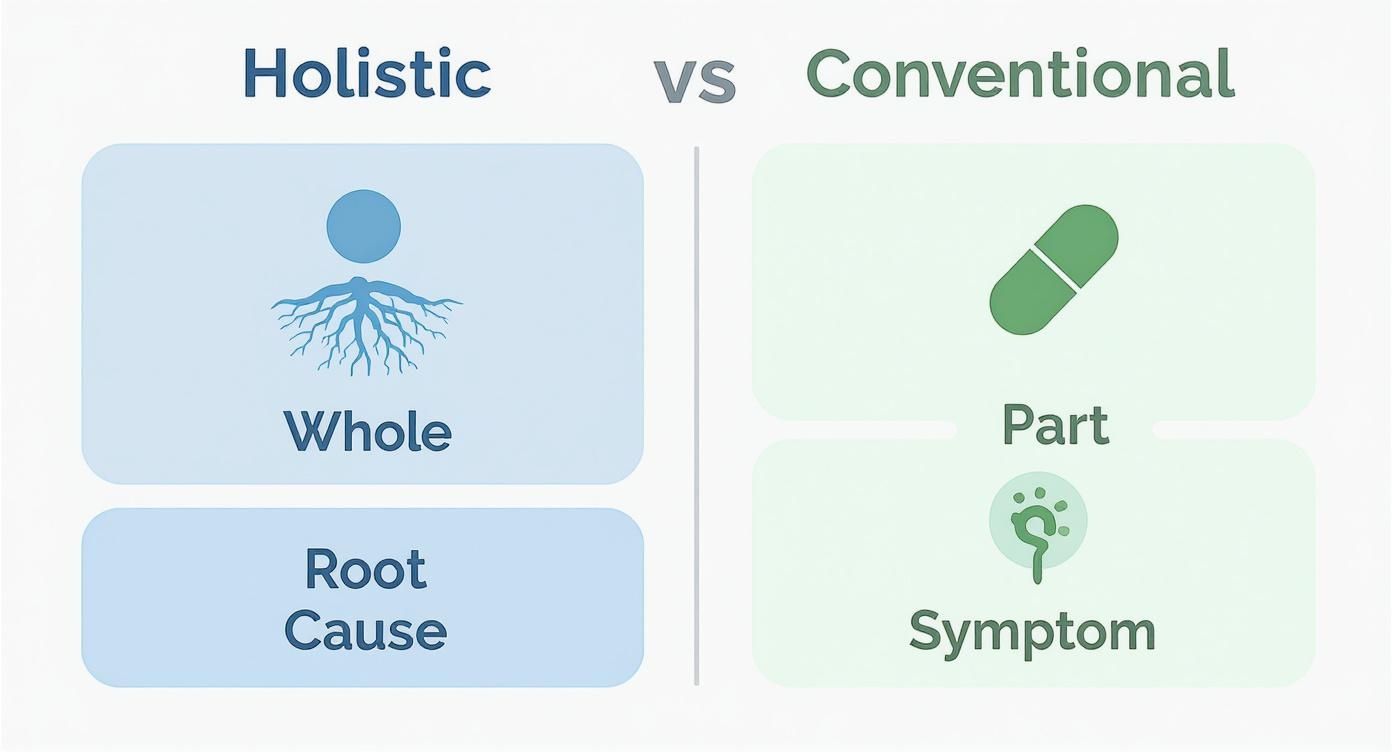
As you can see, the holistic approach zooms out to look at the entire system to find where the problem truly originates, while other methods can get stuck focusing only on where it hurts.
Interrupting the Pain-Stress Cycle
One of the clearest examples of this interconnectedness is what we call the pain-stress cycle. When you feel pain, your body releases stress hormones like cortisol. These hormones don't just affect your mood; they physically cause your muscles to tighten and can actually increase your sensitivity to pain.
Of course, more pain leads to more stress. You start to worry about your ability to work, sleep, or just enjoy life. That emotional distress then triggers an even stronger physical pain response, and the cycle spirals downward. It’s a self-feeding loop that can be incredibly tough to escape with medication alone.
A holistic approach is designed to interrupt this cycle from multiple angles. By addressing the physical pain with therapies like acupuncture while also managing the stress response through mindfulness and lifestyle changes, we can effectively break that feedback loop and help your body find its way back to balance.
This is exactly why we're seeing a major shift toward patient-focused, multidisciplinary care. The global market for pain management products is expected to hit an estimated $150 billion, growing at an 8.5% compound annual rate. This trend isn't just about new pills; it reflects a broader move toward combining traditional and non-traditional treatments for better, more comprehensive results. You can find more details on this growing market trend at Data Insights Market.
When you start seeing your body as this complex, integrated ecosystem, pain changes from an enemy you have to defeat into a valuable signal. It's simply a messenger trying to tell you that something, somewhere in your system, needs attention. This shift in perspective is the first—and most important—step toward finding real, lasting relief.
Ancient Wisdom for Modern Pain Relief
To really get a handle on holistic pain management, it helps to look at practices that have been tested and refined for thousands of years. These methods aren't outdated relics; they offer a profound understanding of the body's incredible ability to heal itself. Instead of just slapping a bandage on a symptom, they dig deeper to address the root imbalances causing the pain in the first place.
Let's unpack some of these key therapies. We’ll go beyond simple definitions to see how they actually work, because each one provides a unique toolkit for restoring balance and getting your body back on track.
Acupuncture: Unblocking Your Body's Pathways
Think of your body's energy pathways and nervous system as the electrical wiring in your house. When the current flows freely, the lights are on and everything works perfectly. But if there’s a short circuit or a block somewhere, you might get a flickering bulb or a whole room that goes dark.
Acupuncture is a bit like calling in a master electrician for your body. By inserting incredibly fine needles at specific points along these pathways (or meridians), we can clear the blockages and get everything flowing smoothly again. It’s a precise and targeted way to restore communication within the body.
This process does a few key things:
- Releases natural painkillers: It prompts your body to release endorphins—its own powerful, built-in pain-relieving chemicals.
- Reduces inflammation: Acupuncture can help calm down the inflammatory response right at the source of the pain.
- Improves circulation: Boosting blood flow brings more oxygen and nutrients to injured tissues, which is crucial for speeding up the healing process.
If someone is dealing with chronic migraines, for instance, acupuncture can release deep-seated tension in the neck and shoulders while helping to regulate the nerve signals that trigger the headaches. It’s a powerful tool, and you can learn more by exploring the core principles of what is Traditional Chinese Medicine and its view of the body as an interconnected system.
Herbal Medicine: Nature's Pharmacy
Herbal medicine is all about synergy. You wouldn't try to build a healthy body by eating only carrots, right? Even though carrots are good for you, they can't give you everything you need. A varied, balanced diet is always more powerful.
Herbal formulas work exactly the same way. A skilled practitioner doesn't just hand you a single herb for a single symptom. Instead, they create a custom blend where every ingredient has a specific job.
Just as a well-conducted orchestra creates a beautiful symphony, a well-designed herbal formula combines different ingredients to create a powerful, balanced therapeutic effect that a single herb could not achieve alone.
In a formula for joint pain, some herbs might target inflammation, others might work to improve circulation to the joint, and still others could be there to support your body's overall energy so it can heal itself more effectively. It’s a truly personalized approach.
Cupping: Releasing Deep-Seated Tension
Picture a rope that’s become a tangled, knotted mess. If you just pull on both ends, you'll only make the knots tighter. The smart way to fix it is to gently lift and separate the fibers, creating space for them to unwind.
That's a great way to understand what cupping therapy does for your muscles and connective tissues. By creating suction on the skin with glass or silicone cups, the technique lifts the tissue, decompressing the tight layers underneath.
This simple action has some powerful benefits:
- Increases blood flow: The negative pressure acts like a vacuum, drawing fresh, oxygenated blood into areas that feel stagnant and tight.
- Releases fascia: It helps loosen up the fascia—that thin "shrink wrap" of connective tissue that encases every muscle and organ.
- Reduces muscle knots: By gently pulling the tissue layers apart, cupping can release stubborn trigger points that other therapies can't reach.
For an athlete with a tight hamstring or an office worker with nagging shoulder pain from being hunched over a desk, cupping can bring almost immediate relief by untangling those knotted-up tissues.
Tui Na: Targeted Manual Therapy
While it might look like a massage, Tui Na is a much more specific and goal-oriented form of manual therapy. It's a key part of holistic pain management because it’s not just about general relaxation. The real goal is to work on the same acupressure points and meridians used in acupuncture.
You can almost think of it as acupuncture without the needles. The practitioner uses a combination of targeted pressure, stretching, and joint manipulation to open up blockages and get energy moving correctly. It’s incredibly effective for musculoskeletal problems like joint pain, sciatica, and muscle spasms, delivering hands-on relief right where you need it most.
Integrating Mind-Body Practices Into Daily Life
True holistic pain management goes far beyond what happens in the treatment room. While acupuncture, herbs, and other therapies are powerful tools, lasting relief comes from weaving principles of self-care and mindfulness into the very fabric of your daily life. This is where you become an active partner in your own healing, turning small, consistent efforts into major improvements in how you feel.

This isn’t about adding more chores to your already busy schedule. It’s about making subtle, mindful shifts that empower your body's innate ability to heal. Think of these daily practices as reinforcing the work we do in the clinic, building a strong, resilient foundation for long-term wellness.
Strengthening The Mind-Body Connection
It’s no secret that our mental and emotional states are deeply intertwined with physical pain. When we’re stressed, our bodies release a cascade of hormones that make muscles tighten and ramp up pain sensitivity. It's a vicious cycle: stress causes pain, and pain causes more stress. Mind-body practices are your key to breaking that cycle.
Something as simple as a five-minute breathing exercise can work wonders. Just find a quiet spot, inhale slowly, hold your breath for a count of four, and then exhale completely. This small act is incredibly effective at calming the nervous system and dialing down stress hormones, offering almost immediate relief.
For those looking to go deeper, exploring mindful meditation practices for well-being can be a game-changer. These techniques are also fantastic for managing anxiety; you can even complement your practice with our guide on specific acupressure points for anxiety.
Embracing Anti-Inflammatory Nutrition
What you eat can either fan the flames of inflammation or help put them out. A diet loaded with processed foods, sugar, and unhealthy fats is like pouring gasoline on the fire of chronic pain. An anti-inflammatory diet, on the other hand, gives your body the exact nutrients it needs to soothe irritation and begin to repair damaged tissues.
You don't have to overhaul your entire diet overnight. Start with a few manageable changes:
- Add Omega-3s: Bring in more fatty fish like salmon, or plant-based sources like walnuts and flaxseeds, to actively reduce inflammation.
- Spice Things Up: Turmeric is a powerhouse. Its active compound, curcumin, is a potent anti-inflammatory. Try adding it to curries, soups, or even a golden milk latte.
- Eat the Rainbow: Fill your plate with a variety of colorful fruits and vegetables. They are packed with antioxidants that protect your cells from stress and damage.
- Cut Back on Problem Foods: Slowly reduce your intake of sugary drinks, refined carbs like white bread, and processed snacks.
Think of your food as medicine you take with every single meal. By consistently choosing foods that nourish and soothe, you are actively dismantling the inflammatory processes that drive so much of your pain.
This kind of proactive self-management is gaining traction worldwide. The International Association for the Study of Pain (IASP) has emphasized these approaches, especially where chronic pain affects over 20% of the population but access to conventional medicine is scarce. Their work shows that a comprehensive, holistic strategy is the only way to effectively manage pain on a global scale. You can see more in their advocacy materials about this global initiative.
Adopting Therapeutic Movement
When you’re in pain, the last thing you want to do is move. I get it. But the right kind of movement is absolutely essential for healing. Gentle, therapeutic activities can improve flexibility, strengthen the muscles that support you, and increase blood flow to sore areas—all without causing more strain.
These practices are designed to be restorative, not exhaustive. They focus on mindful motion, connecting your breath to your body's movements in a way that feels good.
Gentle Movement Options to Consider:
- Yoga: A fantastic combination of physical postures, breathing techniques, and meditation. It’s particularly effective for easing stubborn low-back and neck pain.
- Tai Chi: This ancient practice involves slow, flowing movements that are incredible for improving balance, reducing stiffness, and managing pain from conditions like osteoarthritis.
- Gentle Stretching: Even simple, daily stretches can prevent muscles from getting stiff and improve your range of motion—a must for anyone who sits at a desk.
The most important rule is to listen to your body. Never push through sharp pain. Consistency is far more important than intensity here. Even 15-20 minutes of gentle movement each day can make a huge difference in your pain levels and overall well-being over time. By weaving these practices together, you create a powerful, self-sustaining system for taking back control of your health.
Building Your Personalized Path to Wellness
Taking a holistic approach to pain management is really about stepping into the driver's seat of your own health. It’s a shift away from just chasing symptoms and toward building a strong, resilient foundation for a life with less pain.
This philosophy isn't about pitting one type of medicine against another. Instead, it’s about smart integration. We create a personalized roadmap to wellness that blends the best of all worlds—marrying ancient wisdom with modern science to fit your specific needs. This makes you an active partner in your own healing, not just a passive patient.
Your Role in the Healing Journey
For this to truly work, your voice is the most important one in the room. Being open and honest with your healthcare provider about your goals, your concerns, and what you’re experiencing is absolutely critical. Look for practitioners who genuinely listen and see you as a collaborator in restoring your body's balance.
This path is also a commitment to your entire being. While exploring these therapies, don't forget the powerful impact of your daily habits. For a deeper dive, check out these top tips on hydration, nutrition, exercise, and sleep that can support your journey.
The ultimate message here is one of empowerment and hope. When you treat the whole person—mind, body, and spirit—you create the right conditions for genuine, sustainable healing. Lasting relief from chronic pain isn't just a fantasy; it's an achievable reality.
With the right support and a clear sense of direction, you can explore these powerful modalities and build a wellness strategy that helps you live a fuller, more vibrant life.
Frequently Asked Questions About Holistic Pain Management
It’s completely normal to have questions when you’re thinking about a holistic approach to pain management. After all, it’s a very different way of thinking compared to just treating symptoms. Getting a handle on the practical side of things can give you the confidence you need to take the next step.
Here are some of the most common questions we hear from patients.
Is This a Replacement for My Doctor?
Absolutely not. Think of it as a partnership, not a replacement. Holistic strategies are designed to work with your conventional medical care, creating a much more comprehensive and effective plan for your health.
The goal is to use therapies like acupuncture, nutrition, and stress management to get at the root causes of your pain. Over time, this can often help reduce your reliance on medications. The key is to keep an open conversation going with all your healthcare providers. Before starting anything new, always run it by your primary doctor to make sure it’s a safe and smart choice for your specific situation.
How Quickly Will I See Results?
This is the big question, and the honest answer is: it depends. Every person’s body is different, and the timeline for relief is unique to you. It hinges on the specific therapy we’re using, how long you’ve been dealing with the pain, and your body’s individual response. Some people feel a noticeable shift after just a couple of acupuncture or manual therapy sessions.
For others, especially those with stubborn, long-term chronic conditions, it might take several weeks of consistent treatment and lifestyle adjustments to see significant, lasting change. Holistic healing is about gradual, sustainable progress—not an overnight fix.
This patient approach allows your body to make deep, foundational changes that lead to relief that actually lasts.
Will My Insurance Cover These Therapies?
Insurance coverage for holistic therapies is getting better, but it can still be a mixed bag depending on your provider and plan. The good news is that it's becoming more common for insurance to cover well-established treatments.
- Acupuncture: Many major insurance plans now offer benefits for acupuncture, particularly for chronic back pain and migraines.
- Chiropractic Care: This is another service that is often covered.
- Physical Therapy: Frequently included as a standard benefit for muscle and joint issues.
On the other hand, equally valuable treatments like herbal medicine, cupping, or specialized manual therapies might still be an out-of-pocket expense. Your best bet is always to contact your insurance provider directly. A quick call can give you a clear picture of what your specific plan includes, helping you budget for your care and avoid any surprises.
At Eric Tsai Acupuncture and Herbs, we know navigating insurance can be a headache. That’s why we offer complimentary insurance benefit verification for major providers. Let us handle the details so you can focus on healing.
You can explore our integrative therapies and book a consultation with us today.