
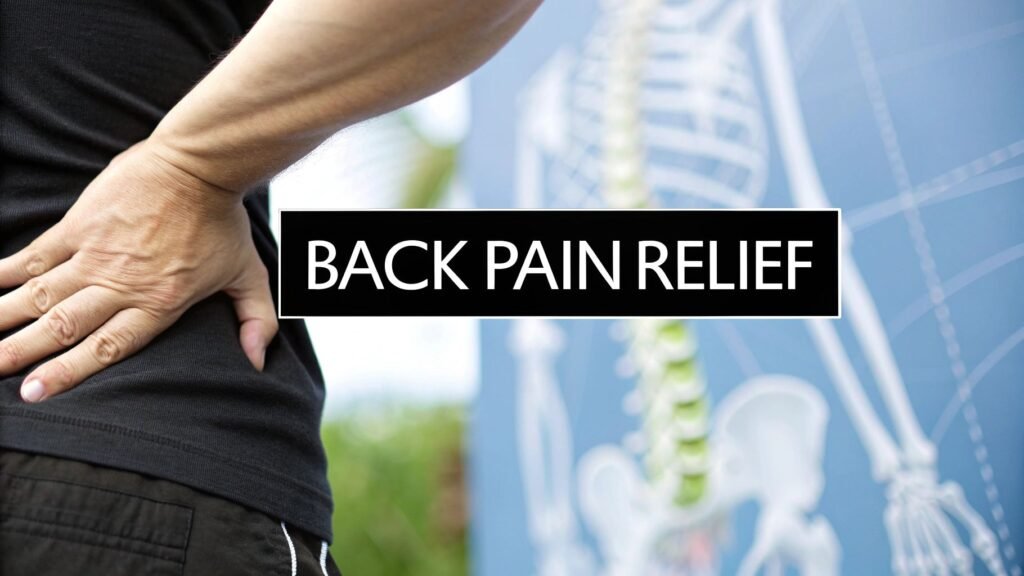
Yes, that nagging back pain you're feeling could absolutely be coming from constipation. It's a real issue, and it happens more often than most people think. When your colon gets backed up, it can actually swell and start pressing on the nerves and muscles in your lower back. This creates a persistent, dull ache that's hard to shake.
It’s like an internal traffic jam creating pressure where it just doesn't belong.
The Hidden Link Between Your Gut and Your Back
We’re all quick to blame a sore back on a bad night's sleep or lifting something the wrong way. But what if the real culprit is hiding in your digestive system? The connection between what’s happening in your gut and the comfort of your muscles and spine is a powerful one that’s too often overlooked.
This guide is here to shine a light on that link, giving you a clear path to understanding—and finally resolving—this specific kind of pain. We’ll explore the intricate relationship between your digestive system and spinal discomfort, reinforcing the profound impact of gut health on overall well-being. Once you see how one system influences the other, you can take much more effective steps toward lasting relief.
Why Is This Connection So Often Missed?
So, why don't more people put two and two together? It’s because the symptoms don't always show up at the same time or in an obvious way. You might have a nagging backache for a few days before it finally dawns on you that you haven't had a proper bowel movement.
This disconnect is common, but the physical relationship is incredibly direct. Your large intestine sits right up against your lower spine, sacrum, and a whole network of nerves. When stool builds up, the colon gets distended and heavy.
Think of your colon as an overinflated balloon. As it expands, it pushes against the structures of your lower back. This constant mechanical pressure can easily irritate nerves, strain muscles, and lead to that familiar, hard-to-pinpoint ache.
This isn't a rare occurrence. Constipation is a significant contributor to back pain precisely because of this pressure. In fact, studies show that up to 20% of adults globally are dealing with constipation at any given time. If that constipation sticks around for more than three weeks, the risk of developing secondary symptoms like back pain goes way up.
Identifying the Symptoms: Is Your Back Pain From Constipation?
Distinguishing this type of back pain from a pulled muscle can be tricky, but there are some tell-tale signs. The pain is often described as a dull, constant ache rather than a sharp, shooting pain. It also tends to be located in the lower back or sacral area.
Use this checklist to quickly determine if your symptoms align with back pain caused by constipation, helping you distinguish it from other back issues.
Symptoms Checklist for Constipation-Related Back Pain
| Symptom | Description | Is This Common? |
|---|---|---|
| Dull, Aching Pain | A constant, nagging ache in the lower back, rather than sharp or stabbing pain. | Very Common |
| Pain Across the Lower Back | Discomfort that spreads across the entire lower back or sacrum, not localized to one spot. | Common |
| Bloating & Abdominal Discomfort | The back pain is accompanied by a feeling of fullness, gas, or cramping in the belly. | Very Common |
| Pain Relief After a Bowel Movement | The backache noticeably eases or disappears after you're able to go to the bathroom. | Very Common |
| No Obvious Injury | The back pain started without any clear trigger, like lifting a heavy object or a sudden movement. | Common |
| Pain Worsens with Inactivity | The ache feels worse when sitting or lying down for long periods. | Sometimes |
If you're ticking off several of these boxes, there's a good chance your gut is the source of your back troubles.
Setting the Stage for Real Relief
Understanding this connection is the first and most important step toward a solution. The goal here isn't to just pop a painkiller and hope for the best. We want to address the root cause—the constipation itself. When you improve your digestive function, the back pain often resolves for good. A great place to begin is by looking at our guide on the best foods for digestive health.
In the rest of this article, we'll walk you through:
- The specific mechanics of how constipation triggers back pain.
- Holistic treatment approaches, including acupuncture and herbal medicine.
- Practical self-care tips you can use for immediate and long-term relief.
By the end, you’ll have a clear roadmap for tackling both issues and bringing your body back into balance.
How Constipation Physically Causes Back Pain
To get a clear picture of how a backed-up gut can lead to an aching back, it helps to think about the body’s internal layout. Your large intestine, especially the colon, isn't just floating around in there. It sits right up against your lower back, very close to the lumbar spine, the sacrum, and a whole network of nerves controlling your legs and pelvic floor.
Because they're such close neighbors, when the colon gets distressed, the back often feels the fallout. It’s not some mysterious connection, but more a simple matter of anatomy and mechanics. When your digestive system is running smoothly, everything coexists peacefully. But when constipation strikes, that delicate balance gets thrown off completely.
The Impact of Mechanical Pressure
The most straightforward cause of back pain from constipation is simple mechanical pressure. Imagine your colon as a long, flexible tube. When you’re constipated, stool backs up and hardens, causing that tube to stretch and swell, almost like an overinflated balloon.
This enlarged colon starts pushing against the structures in your lower back. It can press on the sensitive muscles of the lumbar region and even the sacrum—that bony plate at the very base of your spine. This creates a constant, physical pressure that results in a nagging, dull ache that you just can’t seem to stretch away.
This chart lays out the direct path from a gut problem to back discomfort.

As you can see, it's a pretty direct chain reaction: a backed-up digestive system creates internal pressure that your back feels directly.
Nerve Compression and Referred Pain
It’s not just about general pressure, either. A swollen colon can actually press on specific nerves. The lower part of your colon shares nerve pathways with the muscles in your back and pelvic floor, and the sacral nerves emerging from your sacrum are especially vulnerable. When these nerves get squeezed or irritated by the bloated bowel, the brain can get its wires crossed.
This phenomenon is what we call referred pain.
Referred pain is when a problem starts in one part of the body, but you feel the pain somewhere else. Since the gut and lower back share some of the same nerve wiring, your brain can get confused about the distress signal's origin and register it as "back pain."
This explains why you might not have much abdominal cramping but still have a very real, very sore lower back. The problem is in your gut, but the symptom shows up elsewhere. In severe cases, like a fecal impaction (where stool becomes hard and stuck), the pressure on these nerves can be relentless.
The Role of Inflammation and Muscle Tension
Chronic constipation isn’t just a plumbing issue; it can also kick off a low-grade inflammatory response in the body. The buildup of waste irritates the intestinal lining, and that inflammation can seep into surrounding tissues, including the muscles of your lower back.
This adds another layer to the problem: muscle tension.
The muscles in your abdomen and lower back are designed to work as a team to support your core. When your gut is bloated and uncomfortable from constipation, a few things start to happen:
- Postural Changes: You might find yourself sitting or standing differently to ease the pressure in your belly, which puts a new kind of strain on your back muscles.
- Muscle Guarding: Your body instinctively tightens the muscles around the uncomfortable area to protect it. This can lead to painful spasms and stiffness.
- Psoas Muscle Irritation: The psoas is a major muscle that connects your spine to your legs and runs deep through your abdomen. A swollen colon can easily irritate it, causing tightness that pulls on your lower spine.
All of this creates a frustrating cycle. The constipation causes muscle tension, and those tight, inflamed muscles can make it even harder for your digestive system to function properly. This is why just treating the back pain often gives only temporary relief. For lasting comfort, you have to get to the root of the problem.
Identifying the Signs of Constipation Back Pain
Not all back pain is created equal. The sharp, sudden jolt from lifting something heavy feels completely different from the dull, nagging ache that can show up when your digestion is off. Learning to spot the specific signs of back pain from constipation is the first step—it helps confirm that your gut is the real culprit behind your discomfort.
The trick is to look at the whole picture. Instead of just fixating on where your back hurts, you need to tune into what's happening with your digestive system at the same time. Pain from constipation has its own unique signature; it’s less about a specific injury and more about a general feeling of internal pressure that decides to make itself known in your back.

This kind of back pain rarely shows up alone. It’s almost always part of a bigger constellation of symptoms that, when you put them all together, point directly to a digestive problem.
What Does the Pain Feel Like?
One of the biggest clues is the quality of the pain itself. Unlike the sharp, zinging pain of a muscle strain or the electric shock of a pinched nerve, constipation-related back pain tends to be more widespread and persistent.
Here’s how people often describe it:
- A Dull, Constant Ache: It's more of a stubborn, annoying throb than a sharp, intense sensation. The pain often spreads across the lower back, frequently centered around the sacrum—that bony area right at the base of your spine.
- A Feeling of Pressure: Many people report a sensation of fullness pushing outward from the inside, as if something is pressing on their spine from within the abdomen.
- Worse with Inactivity: The ache can feel more pronounced when you’ve been sitting or lying down for a while, since these positions can ramp up that internal abdominal pressure.
This pain profile is a direct result of the mechanical stress that a backed-up colon puts on all the surrounding muscles, nerves, and bones in your lower back and sacral area.
Key Accompanying Symptoms to Watch For
The clearest way to connect the dots between your backache and constipation is by looking at the symptoms that come along for the ride. Your back might be screaming the loudest, but your gut holds all the evidence. If the two are linked, you'll almost certainly be dealing with a few other digestive issues at the same time.
Keep an eye out for this combination of signs:
- Abdominal Bloating and Cramping: Your stomach feels full, tight, and distended. You might also have crampy pains that seem to come and go.
- A Sensation of Fullness: Even if you haven't eaten much, you feel uncomfortably full. That’s a direct result of digestive waste that just isn't moving.
- Pain Relief After a Bowel Movement: This is the most telling sign of all. If your backache gets noticeably better or even disappears after you finally have a bowel movement, you can be pretty confident you’ve found the connection.
Tracking your symptoms is crucial. Take note of when your back pain flares up and see how it lines up with your bowel movements, bloating, and what you’ve been eating. A clear pattern linking gut distress to back discomfort is your strongest indicator.
Radiating Pain and Less Common Signs
Sometimes, the pain doesn't just stay in your lower back. When the colon is severely impacted, the pressure can irritate the complex network of nerves that travels from your lower spine down into your pelvis and legs. This can cause pain to radiate into your hips, buttocks, or even down your thighs. It feels different from classic sciatica, which is often sharp and travels all the way below the knee.
Interestingly, while nerve irritation is part of the problem, it doesn't always mean a major nerve root is being compressed like in a herniated disc. In a massive study of over one million patients, researchers found that constipation was just as common in people with general back pain (11.1%) as it was in those with specific nerve root pain (10.8%). This suggests that the pressure and referred pain are often bigger factors than direct, severe nerve compression. You can discover more insights on this lumbosacral radiculopathy research.
For those whose pain is focused on one side, our guide on lower right side back pain might offer some extra clarity. Recognizing these distinct patterns is key to getting the right diagnosis and finding a treatment that actually works.
Holistic Relief with Acupuncture and Herbal Medicine
When you're dealing with the twin frustrations of constipation and back pain, standard treatments often feel like they're only fixing half the problem. Traditional Chinese Medicine (TCM) takes a different view, seeing these issues not as separate ailments but as two sides of the same coin. This approach allows us to target the root cause of the digestive backup and find lasting relief.
At the heart of TCM is the concept of Qi (pronounced "chee"), your body's vital energy. Picture it as a current flowing through a river system, nourishing every organ and keeping things running smoothly. When the current is strong and clear, you feel great. But when it gets blocked or "stagnant," a whole host of problems can pop up.

From a TCM standpoint, constipation is a classic case of Qi stagnation in the large intestine. This traffic jam doesn't just slow down your bowels; it creates a physical backup that leads to pressure, bloating, and—you guessed it—that nagging pain that radiates to your lower back. The entire goal of TCM is to get this energy flowing freely again.
How Acupuncture Unblocks the System
Acupuncture is one of our primary tools for getting Qi and blood moving properly. By inserting hair-thin needles into specific points on the body, an acupuncturist can essentially hit a reset button on your body’s internal wiring, sending signals to your nervous system and organs to restore balance.
For back pain stemming from constipation, the treatment is designed to do several things at once:
- Stimulate the Intestines: We use specific acupuncture points on the abdomen and legs that are known to kickstart peristalsis—the natural muscular contractions that move waste along your digestive tract.
- Relax Back Muscles: Other points located on the lower back and hips work directly to ease the muscle tension and inflammation caused by all that internal pressure. This provides immediate relief for the ache and stiffness you feel.
- Regulate Organ Function: In TCM, the Spleen and Stomach systems govern digestion. Acupuncture helps harmonize their function, improving your body's ability to process food and absorb nutrients efficiently.
The real beauty of the TCM perspective is that it sees back pain and constipation not as two separate issues, but as different symptoms of the same core imbalance—stagnant Qi. By restoring that flow, acupuncture helps the body heal both problems simultaneously, rather than just masking the pain.
The end result is a therapy that doesn’t just put a band-aid on your backache but actually resolves the constipation causing it in the first place. You can dive deeper into how acupuncture for digestive issues offers this kind of targeted relief.
The Gentle Power of Chinese Herbal Medicine
Working in tandem with acupuncture, Chinese herbal medicine is a powerful way to address constipation from the inside out. Unlike harsh over-the-counter laxatives, which can create dependency and disrupt your gut, herbal formulas are carefully crafted to gently correct the specific imbalance causing the blockage.
A licensed practitioner will diagnose your unique pattern and create a custom formula just for you. The goal isn't simply to force a bowel movement; it's to restore healthy, sustainable digestive function.
Common herbal strategies include:
- Moistening the Intestines: If stools are particularly dry and hard to pass, certain herbs can help draw more fluid into the colon, naturally softening waste.
- Moving Qi and Blood: Many herbs are fantastic at breaking up the stagnation that causes painful bloating, promoting smooth and comfortable movement through the gut.
- Reducing Inflammation: We can also use anti-inflammatory herbs to calm irritation in the intestinal lining and surrounding tissues, which eases both abdominal discomfort and the referred back pain.
By combining the precise action of acupuncture with the deep, internal support of herbal medicine, TCM offers a truly robust solution. This dual approach not only gets you out of immediate pain but also strengthens your digestive system to prevent the problem from coming back, guiding your body back to a state of natural, easy balance.
Practical At-Home Strategies for Immediate Relief
When you're stuck dealing with an aching back and a stubbornly blocked-up gut, you want relief, and you want it now. The good news is you don’t have to just wait it out. There are several simple yet powerful things you can do right at home to address both problems at once, and you can often start feeling better within a few hours.
The trick is to tackle this from a couple of different angles. First, we need to gently encourage your digestive system to get moving again. At the same time, we need to release all that tension that’s built up in your back muscles. These practical steps are designed to do just that, helping to restore a sense of balance and comfort to your body.
https://www.youtube.com/embed/FI51zRzgIe4
Simple Dietary Adjustments for Better Flow
Often, the most direct path to relief starts on your plate. What you eat and drink can have a massive impact on your digestive rhythm, acting as a natural remedy to soften stool and get things back on track.
You can begin with two fundamental shifts:
- Increase Your Fiber Intake: Think of fiber as a gentle "broom" for your digestive tract. It adds necessary bulk to your stool and helps sweep everything through your system smoothly. Focus on whole foods like berries, beans, avocados, whole grains, and leafy greens.
- Boost Your Hydration: Water is fiber's essential partner. Without enough water, fiber can actually make things worse. Proper hydration softens stool, making it much easier to pass. Since dehydration is one of the top culprits behind constipation, make sure you're sipping water consistently throughout the day.
To make things even clearer, here’s a simple guide to making smart food choices when you’re feeling backed up.
Helpful and Unhelpful Foods for Constipation
This table offers a quick guide to making dietary choices that support regularity and can help prevent constipation-related back pain.
| Food Category | Foods to Eat | Foods to Limit |
|---|---|---|
| Fruits | Pears, apples, berries, prunes, kiwi | Unripe bananas, processed fruit snacks |
| Vegetables | Broccoli, Brussels sprouts, leafy greens | Fried vegetables, canned vegetables with high sodium |
| Grains | Oatmeal, whole-wheat bread, brown rice | White bread, white rice, sugary cereals |
| Proteins | Beans, lentils, chickpeas | Red meat, processed meats, fried foods |
| Dairy | Yogurt with probiotics, kefir | Large amounts of cheese and milk |
Even small dietary shifts can make a surprisingly big difference in your regularity and, in turn, how your back feels.
Gentle Stretches to Relieve Pressure
It’s a natural reaction: when you’re constipated, the internal pressure causes the muscles in your lower back to tense up. Gentle stretching is a fantastic way to not only release this tightness but also to physically stimulate your digestive system. Think of these movements as a way of giving your internal organs a gentle massage to encourage movement.
Try weaving a few of these simple stretches into your day:
- Knee-to-Chest Hug: Lie on your back and gently pull one knee toward your chest, holding for 20-30 seconds before switching sides. This gentle compression of the abdomen can help stimulate the colon.
- Pelvic Tilts: While lying on your back with your knees bent and feet flat on the floor, gently rock your pelvis back and forth. This simple motion is wonderful for loosening tight lower back muscles and massaging the abdominal area.
- Child's Pose: A classic for a reason. This yoga pose provides a soothing stretch for the lower back while applying mild, helpful pressure to the abdomen, which can encourage gas to pass and stimulate digestive flow.
Remember to move slowly and breathe deeply through each stretch. The goal here is relaxation, not force. When you're dealing with back pain due to constipation, consistent, gentle movement is always more effective than anything aggressive.
Improving Toilet Posture and Habits
Believe it or not, how you sit on the toilet can make a huge difference. Straining is one of the worst things you can do, as it dramatically increases pressure inside your abdomen and forces your core and back muscles to clench, making back pain even worse. The modern toilet, as it turns out, puts our bodies in a less-than-ideal position for this process.
The solution is remarkably simple: put your feet up.
By placing a small stool (like a Squatty Potty) under your feet, you change your body's alignment. This simple shift in posture helps straighten out the rectum, creating a clearer path for stool to pass easily and with far less straining. It’s a small change that can provide immediate relief and help prevent future flare-ups.
When It's Time to See a Doctor
While you can often manage back pain from constipation at home, it’s vital to know when self-care isn't cutting it. Sometimes, these symptoms are your body's way of signaling a deeper issue that needs a professional diagnosis.
Most of the time, that nagging ache will disappear once your digestive system is moving smoothly again. But if the pain sticks around or gets worse even after you've tried all the usual home remedies, that's your cue to call a doctor.
Don't Ignore These Red Flags
Think of certain symptoms as alarm bells. If they show up, you need to get a medical opinion right away. If you're dealing with back pain and constipation, book an appointment if the pain is severe, constant, or doesn't ease up after you've had a bowel movement.
You should seek immediate medical help if you experience any of these alongside your other symptoms:
- Fever or Chills: This combination often points to an infection that needs prompt treatment.
- Unexplained Weight Loss: Suddenly losing weight without trying can be a sign of a more significant health problem.
- Numbness, Tingling, or Weakness: If you feel any loss of sensation or strength in your legs, groin, or buttocks, it could signal nerve involvement.
- Loss of Bladder or Bowel Control: This is a serious medical emergency and requires immediate attention.
It's easy to write off back pain as a simple side effect of being backed up, but when combined with these other symptoms, it could point to something more serious like a bowel obstruction, a spinal problem, or a severe infection. Don't hesitate to get checked out.
When Constipation Becomes Chronic
Even if you don't have any of those alarming red flags, chronic constipation is reason enough to see a doctor. If you’ve been struggling with infrequent or difficult bowel movements for more than a couple of weeks, it's time to get some professional advice.
Low back pain is a massive global health issue, affecting an estimated 619 million people in 2020. That number is expected to climb to 843 million by 2050. Getting to the bottom of chronic constipation is a proactive way to manage and prevent one of its most painful side effects. A healthcare provider can help you figure out what’s causing the digestive slowdown and create a treatment plan that actually works for the long haul.
Answering Your Questions About Constipation and Back Pain
When you’re stuck with a sore back and a gut that won’t cooperate, it’s easy to feel frustrated and confused. You probably have a lot of questions. Getting clear answers is the first step toward feeling in control and finding a path to relief. Let’s tackle some of the most common concerns I hear from patients.
How Long Does Back Pain from Constipation Usually Last?
Here’s the good news: this kind of back pain is almost always temporary. The discomfort is a direct result of the physical pressure from a full colon pushing against the nerves and muscles in your lower back.
Once you finally have a complete bowel movement, that internal pressure vanishes. For most people, the back pain fades away within a few hours. If your constipation was particularly severe, you might feel some lingering muscle tension for a day or so, but it should steadily improve.
The most telling sign is that immediate sense of relief in your back right after you've cleared your bowels. That cause-and-effect feeling is the clearest indicator that the constipation was the real culprit.
If the back pain sticks around long after your digestion is back on track, it’s a strong signal that something else is going on.
Can Stress Trigger Both Problems at Once?
Without a doubt. Stress is a powerful force that can wreak havoc on both your digestive and musculoskeletal systems. When you’re stressed, your body goes into "fight or flight" mode. This survival response pulls resources away from processes it deems non-essential, like digestion, which can slow everything down and lead straight to constipation.
At the same time, stress makes you tense up. Your shoulders, neck, and especially your lower back muscles can become tight and guarded. It's incredibly common for someone to come into my clinic with both back pain and constipation after a tough week at work. It creates a vicious cycle where the gut issues make the back feel worse, and the back pain adds to the overall stress.
Are Over-the-Counter Laxatives a Good Idea?
While an over-the-counter (OTC) laxative might offer a quick fix for the constipation itself, it’s just a bandage, not a real solution. Think of it as silencing one alarm bell without checking for the fire.
Sure, clearing the blockage will likely ease the back pain caused by constipation, but relying on laxatives regularly can create a whole new set of problems.
- Dependency: Your digestive system can start to depend on the chemical stimulation, making it even harder to have a natural bowel movement down the road.
- Ignoring the Root Cause: Laxatives do absolutely nothing to address why you’re constipated. Is it your diet? Dehydration? Stress? A deeper imbalance?
- Unpleasant Side Effects: Many people find that laxatives cause uncomfortable cramping, gas, and bloating.
A much better approach is to focus on foundational health: improving your diet, drinking more water, moving your body, and managing stress. For more direct support, holistic treatments like acupuncture and herbal medicine can help get your body’s natural rhythm back on track without creating dependency.
At Eric Tsai Acupuncture and Herbs, my focus is always on finding and treating the root cause of your discomfort, not just chasing symptoms. If you're struggling with this frustrating combination of issues, a personalized approach can help bring your body back into balance for good. Schedule a consultation today and start your path toward lasting relief.