
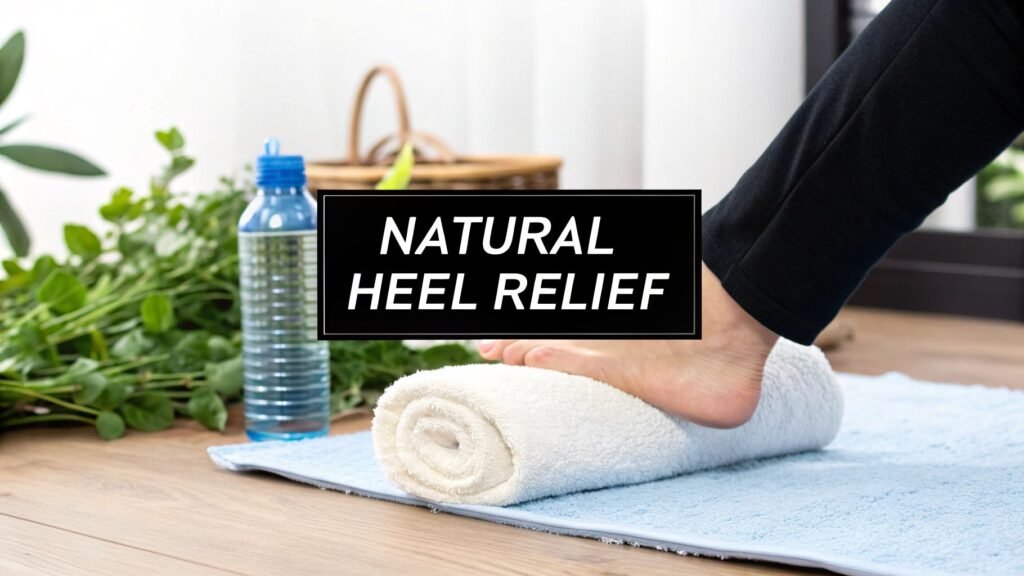
Dealing with plantar fasciitis means getting back to basics. A consistent, natural approach combining stretching, strengthening, and self-massage is often the most effective path to relief. When you add supportive footwear and a few smart lifestyle tweaks, you’re not just masking the pain—you’re treating the problem at its source. True, lasting relief comes from giving that inflamed tissue in your foot the chance to finally heal.
Understanding How Natural Healing Works for Plantar Fasciitis
Before we dive into the exercises, let’s get a clear picture of what’s going on inside your foot. The plantar fascia is a thick, web-like band of tissue that runs from your heel to your toes. It’s essentially your foot's built-in shock absorber. Plantar fasciitis flares up when that tissue gets overstretched and develops tiny tears, which is why you feel that sharp, stabbing pain—especially with those first few steps out of bed.
A natural treatment plan works so well because it helps your body do what it does best: repair itself. Instead of jumping to invasive procedures, you’re creating the perfect environment for healing through simple, targeted self-care.
Pinpointing the Root Cause of Your Pain
To really solve the problem, you first need to figure out what’s causing it. Plantar fasciitis doesn't just show up out of the blue; it's almost always the result of accumulated stress over time.
Think about what might be contributing. Common culprits I see in my practice include:
- Unsupported Footwear: Old, worn-out shoes, or ones that are too flat, put a massive strain on your plantar fascia.
- Overuse or Abrupt Changes: Suddenly ramping up your running mileage or starting a new job where you're on your feet all day can easily overload the tissue.
- Foot Mechanics: Both flat feet and unusually high arches can mess with your gait, leading to uneven pressure on your foot.
- Body Mechanics: It's not always just about the foot. Tight calf muscles or even weak glutes can change the way you walk, putting extra stress right where you don't want it.
Once you identify your personal triggers, you're halfway to preventing the pain from coming back. Adopting a holistic approach to pain management helps you connect the dots between your heels and the rest of your body.
Why a Conservative Approach is So Powerful
Here’s the great news: you probably don’t need aggressive interventions to get better. In fact, research shows that conservative, non-invasive treatments are incredibly effective.
About 90 percent of patients find complete relief using these simple methods alone. Sometimes the most successful treatments for heel pain are also the most straightforward and inexpensive.
By focusing on the fundamentals—stretching, strengthening, proper support, and anti-inflammatory habits—you give your body the tools it needs to heal itself. This is the core principle behind treating plantar fasciitis naturally and effectively.
Of course, everyone wants to heal quickly. While patience is part of the process, it’s understandable to look for faster solutions and wonder how to cure plantar fasciitis in one week. This guide, however, is all about building a sustainable plan for relief that actually lasts.
At a Glance Guide to Natural Recovery
To give you a clear roadmap, here's a quick summary of the core pillars of a successful natural recovery plan. Think of these as the non-negotiable components of your daily routine for the next several weeks.
| Treatment Pillar | Primary Goal | Examples |
|---|---|---|
| Daily Self-Care | Reduce inflammation and improve tissue flexibility. | Calf stretches, foot rolling, icing, and toe curls. |
| Supportive Footwear | Minimize daily strain on the plantar fascia. | Shoes with good arch support, orthotic inserts, no barefoot walking. |
| Lifestyle & Diet | Lower systemic inflammation and promote tissue repair. | Anti-inflammatory foods, proper hydration, managing weight. |
| Complementary Therapies | Enhance healing, improve blood flow, and reduce pain. | Acupuncture, cupping, targeted herbal formulas. |
This table lays out the foundational elements we’ll be exploring in detail. By consistently applying these strategies, you create a powerful healing environment for your feet.
Daily Self Care for Immediate Pain Relief
When you’re in the thick of a plantar fasciitis flare-up, that first step out of bed can feel like walking on glass. The immediate goal is simple: calm things down. This daily routine is your go-to playbook for easing the inflammation and tension that’s causing all that grief.
The secret weapon here is consistency. By weaving these simple actions into your daily life, you’re not just chasing temporary relief—you’re laying the groundwork for real, lasting healing.
This approach is all about understanding the "why" behind the pain and taking targeted steps to fix it, which is the core of any effective natural healing plan.
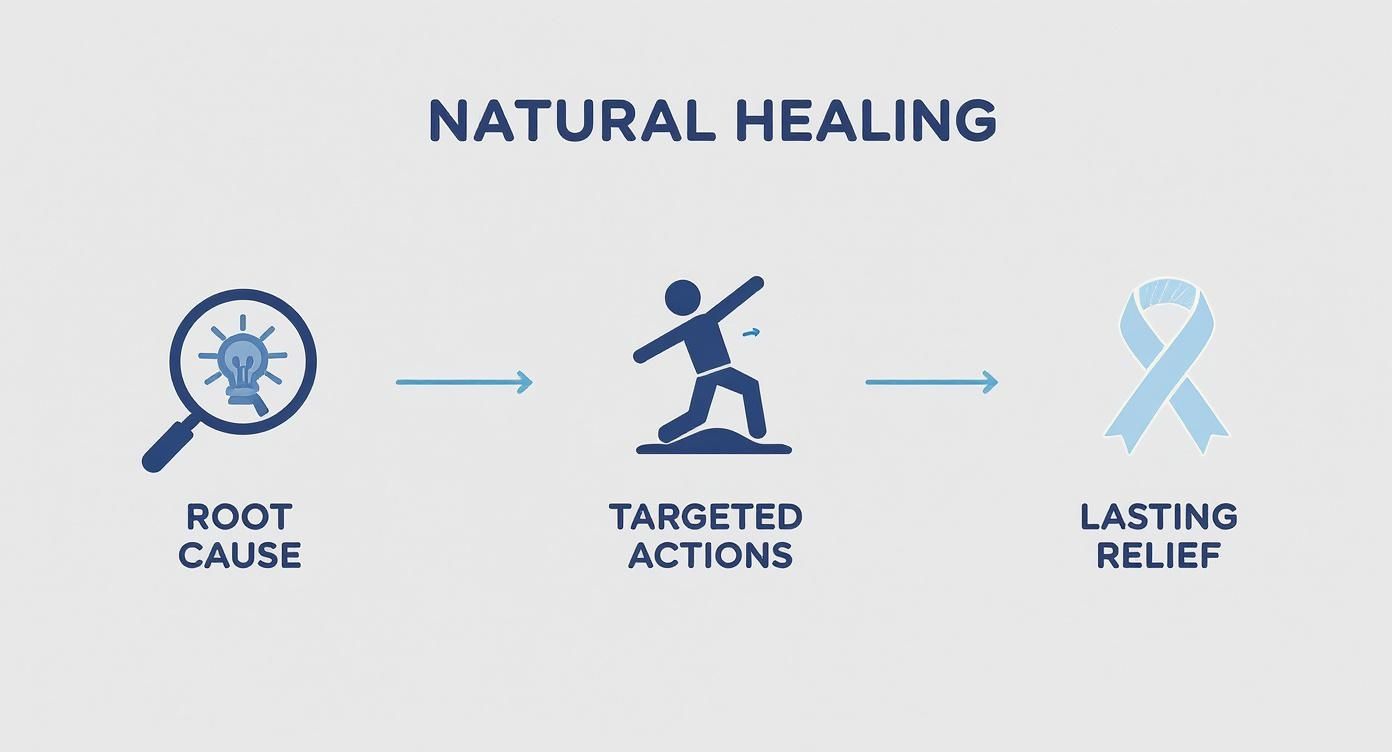
As you can see, it starts by pinpointing the root cause. From there, consistent actions like stretching and massage directly address the problem, paving the way for a full recovery.
Essential Stretches to Start and End Your Day
If you do nothing else, stretch. For plantar fasciitis, stretching is completely non-negotiable. It’s what helps loosen up the tight, overworked tissues that are constantly yanking on your heel bone.
Making these stretches the very first thing you do in the morning can make a world of difference for that dreaded morning hobble.
-
Wall-Facing Calf Stretch: This one’s a classic for a reason. Stand about an arm's length from a wall and place your hands on it for support. Step one foot back, making sure to keep that leg straight and your heel firmly on the floor. Gently lean in until you feel a good stretch in your calf. Hold it for 30 seconds, then switch. Aim for three reps on each leg.
-
Towel-Assisted Plantar Fascia Stretch: Do this one before you even get out of bed. Sit up with your legs stretched out in front of you. Grab a towel, loop it around the ball of the foot that’s hurting, and gently pull back. You should feel the stretch right in the arch of your foot. Hold for 30 seconds, and repeat it three times.
A Quick Word of Caution: Your goal is a gentle, sustained pull, not sharp pain. Pushing too hard will only aggravate the already-inflamed tissue. Listen to your body.
Targeted Self-Massage for Painful Trigger Points
Massage is another fantastic tool for getting some immediate relief. It works by breaking up tiny knots and adhesions in the tissue and, just as importantly, boosting blood flow to the area to kickstart the healing process. You don't need any fancy gadgets, either.
A frozen water bottle is one of the most effective tools I recommend to patients. It’s a brilliant two-for-one, giving you the benefits of massage and icing at the same time. Just sit down, place the frozen bottle under your foot, and roll it from heel to toe for about 10 to 15 minutes. Use enough pressure to feel it working, especially on the tender spots.
For a more focused approach, try a lacrosse ball or even a tennis ball. While seated, roll the ball under your foot until you find a sore trigger point. Pause there and apply steady pressure for 15 to 20 seconds. It might feel intense, but it’s incredibly effective at releasing deep tension. For those interested in more structured manual therapies, exploring the benefits of Tui Na massage can offer deeper insight into how skilled touch helps relieve musculoskeletal pain.
A Smart Icing Protocol to Reduce Inflammation
The throbbing pain of plantar fasciitis is driven by inflammation. Icing is your most direct and effective weapon against it. When done right, it can dramatically reduce swelling and provide that much-needed soothing feeling after a long day.
Think of icing as a non-negotiable part of your recovery. Here’s a simple but effective way to do it:
- Time it Right: Apply ice for 15 to 20 minutes at a time. Going longer doesn’t help more and can actually risk skin or nerve irritation.
- Be Consistent: Ice your heel 2 to 3 times a day. It's especially crucial after you've been on your feet for a while or at the very end of your day.
- Pick Your Tool: A gel pack, a bag of frozen veggies wrapped in a tea towel, or the frozen water bottle you used for massage all work perfectly.
This isn’t just about numbing the pain; it’s an active treatment. By bringing down the inflammation, you’re creating the calm environment your plantar fascia needs to finally start healing. This powerful trio—stretching, massage, and icing—is the foundation of your daily self-care.
Building Foundational Strength and Support
While daily stretches and icing can bring some much-needed relief, they're really just managing the symptoms. The real key to a lasting recovery from plantar fasciitis is building a solid foundation of strength and support. This is how we shift from just putting out fires to actually fireproofing the whole structure.
Think of it this way: your foot has a network of small, intrinsic muscles designed to support your arch. When these muscles are weak, the plantar fascia has to pick up the slack, working overtime until it gets inflamed and angry. The goal is to wake up those little muscles and get them doing their job again, taking the enormous strain off that sensitive tissue.
Simple Exercises to Strengthen Your Arches
You don’t need any fancy gym equipment for this. In fact, you can do these simple, incredibly effective exercises while you’re watching TV or even sitting at your desk. It’s all about consistency—just a few minutes a day really adds up.
-
Towel Curls: This one’s a classic for good reason. Sit in a chair, feet flat on the floor, and lay a small towel out in front of you. Using just your toes, slowly scrunch the towel toward you. Once you get it all the way, push it back out and start again. Do this for 10-15 repetitions and then switch feet.
-
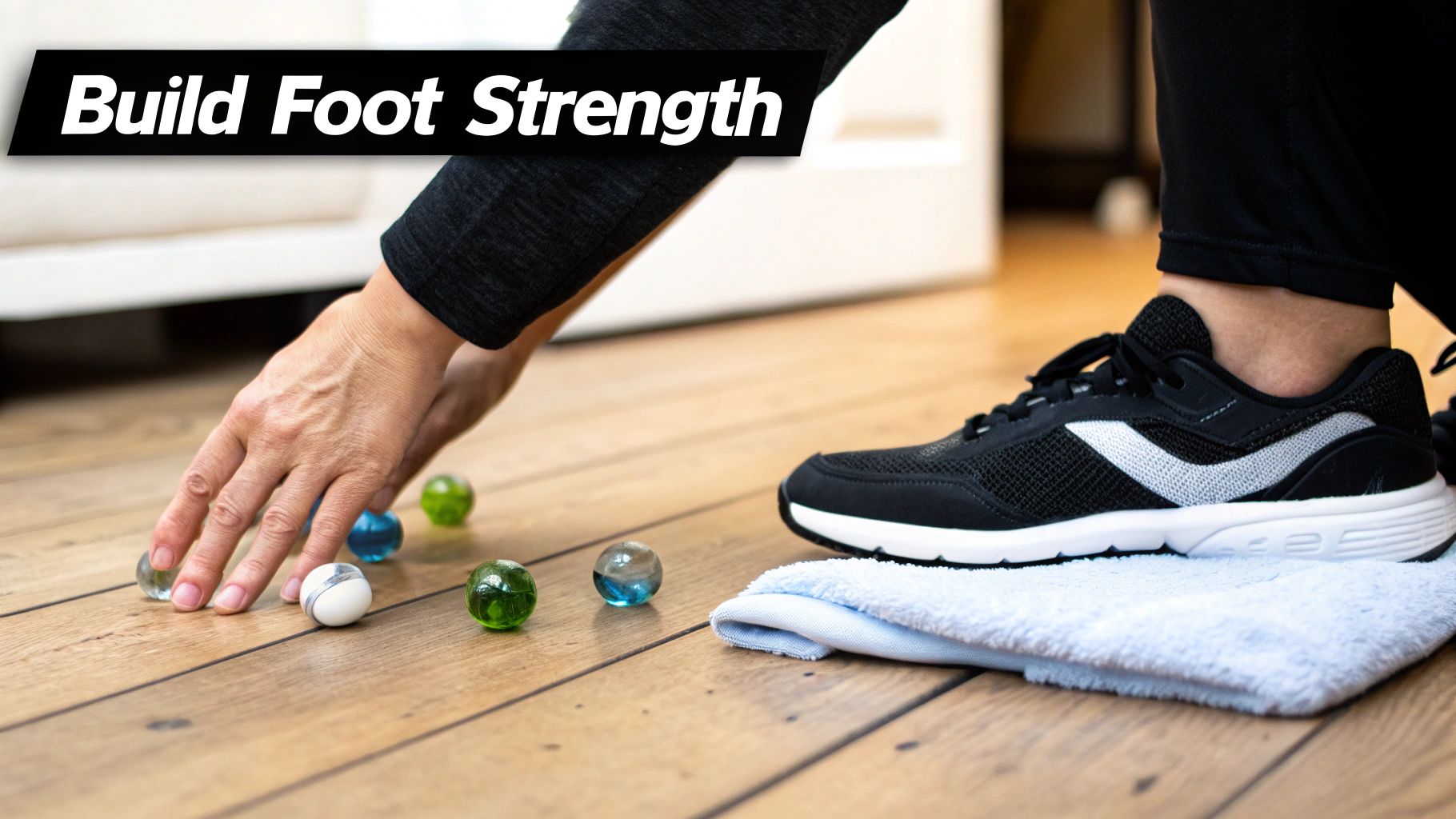
Marble Pickups: This feels almost like a game, but it's a powerhouse for isolating those deep foot muscles. Scatter a handful of marbles on the floor and use your toes to pick them up, one by one, and drop them into a small bowl.
-
Toe Splaying: While sitting, simply try to spread your toes as far apart as possible. Hold that spread for about five seconds, then relax. This move is fantastic for improving not just strength but also the brain-to-muscle connection that governs your foot's stability.
These might seem like small, insignificant movements, but they are absolutely fundamental to restoring proper foot mechanics. This is a core part of learning how to treat plantar fasciitis naturally for good.
Looking Beyond the Foot: Your Body's Kinetic Chain
Plantar fasciitis is almost never just a foot problem. I see it all the time in my practice—the root cause is often hiding further up the leg. Your body is a linked system, what we call a kinetic chain, and a weak link anywhere can cause trouble downstream. For your feet, the biggest culprits are usually the calves and glutes.
When your calf muscles are chronically tight, they pull on the Achilles tendon. Since the Achilles is connected directly to the plantar fascia, this creates a constant, low-grade tugging that irritates your arch. At the other end, weak glutes can completely throw off your gait, causing your foot to land awkwardly and absorb shock unevenly with every single step.
A common mistake I see people make is focusing all their efforts on the spot that hurts. A truly successful natural treatment plan has to look at the whole picture—from your hips all the way down to your toes—to fix the mechanical issues that started the fire in the first place.
The Role of Supportive Footwear
The shoes you put on every morning can either be your greatest ally or your worst enemy in this fight. The right pair provides a healing environment for your fascia, while the wrong pair can undo all your hard work in a single afternoon. Rule number one during recovery: no more going barefoot on hard surfaces.
When you're shopping for new shoes, here's what to look for:
- A Firm Heel Counter: Squeeze the back of the shoe. It should feel rigid and solid, not flimsy. This is crucial for controlling unwanted heel movement.
- Good Arch Support: The shoe shouldn’t be perfectly flat inside. It needs a supportive, built-in arch that contours to your foot.
- A Slight Heel Lift: A modest heel-to-toe drop of around 10-12mm can gently take some of the tension off both the Achilles and the plantar fascia.
- Minimal Flexibility: A supportive shoe should only bend where your foot bends—at the ball. If you can easily fold the shoe in half, it’s not going to give you the stability you need.
Finding the right fit is also essential, especially for those with wider feet. This ultimate guide to wide width shoes for maximum comfort is a great resource.
Adding Extra Support with Insoles and Taping
Sometimes, especially in the early, painful stages, even a great pair of shoes needs a little help. That's where over-the-counter insoles or a bit of athletic tape can be game-changers.
-
Over-the-Counter Insoles: You don't need to jump straight to expensive custom orthotics. Look for a quality pair of semi-rigid insoles that have a deep heel cup and pronounced arch support. These can make an immediate difference by cushioning the heel and preventing your arch from collapsing with each step.
-
Athletic Taping: A "low-Dye" taping technique can feel like a miracle for an aching arch. It essentially creates a temporary, external support system that offloads the plantar fascia. This is especially helpful before a long walk or a day you know you'll be on your feet a lot. You can find plenty of video tutorials online, or better yet, have a physical therapist show you how to do it correctly.
Lifestyle and Diet Changes That Support Healing
True, lasting recovery from plantar fasciitis goes beyond just daily exercises. What you do in the kitchen and how you approach physical activity can either accelerate your healing or keep you frustratingly stuck in a cycle of pain. By making conscious choices about your diet and fitness, you're creating an internal environment that actively promotes tissue repair.
This isn't just about avoiding things that hurt. It’s about proactively giving your body the raw materials it needs to rebuild and get stronger. You'd be surprised how much simple lifestyle adjustments can help, calming inflammation from the inside out and reducing the mechanical load on your feet every single day.

Embrace an Anti-Inflammatory Diet
The sharp, stabbing pain of plantar fasciitis is driven by inflammation. While ice packs target this on the surface, your diet can fight it systemically. Honestly, adopting an anti-inflammatory diet is one of the most powerful tools you have, helping to soothe irritated tissues not just in your feet, but throughout your entire body.
The idea is simple: load up on whole, nutrient-rich foods that naturally combat inflammation while steering clear of the stuff that fuels it.
-
What to Eat More Of: Think foods rich in omega-3s, antioxidants, and phytonutrients. This means adding more fatty fish like salmon, colorful berries, and leafy greens to your plate. Healthy fats from avocados, nuts, and olive oil are also fantastic. Don't forget spices—turmeric and ginger are powerful, natural anti-inflammatories.
-
What to Cut Back On: On the other side of the coin are foods that promote an inflammatory response. Try to significantly reduce your intake of processed sugars, refined carbs (like white bread and pastries), and unhealthy trans fats often found in fried and packaged foods.
Think of it this way: every meal is an opportunity to either calm the fire or add more fuel to it. An anti-inflammatory eating style isn't about a restrictive diet; it's about making smarter choices that support your body's healing process.
This approach is a cornerstone of any strategy for how to treat plantar fasciitis naturally. For a deeper look at this, check out our detailed guide on how to reduce inflammation through your daily habits.
Address the Impact of Body Weight
This can be a sensitive subject, but we have to talk about it because it's so important. Your feet bear the entire weight of your body with every step. The force hammering down on your feet when you walk can be up to 1.5 times your body weight.
What this means is that even a small reduction in weight can dramatically decrease the daily strain on your plantar fascia. It's pure physics. Less load means less stress on that inflamed tissue, giving it the breathing room it needs to finally heal.
Focus on sustainable changes, not crash diets. Combining the anti-inflammatory eating plan with gentle, low-impact exercise is a practical and highly effective strategy. Many of my patients find that losing just 5-10% of their body weight makes a world of difference in their heel pain.
Modify Your Fitness Routine Intelligently
Being told to rest your foot doesn't mean you have to stop moving. In fact, staying active is crucial for your physical and mental health during recovery. The secret is to intelligently swap high-impact activities for ones that don't pound on your heels.
Continuing to run or do jump training while your fascia is inflamed is like picking at a scab—you're just preventing it from healing and likely making it worse.
Instead, let's explore some foot-friendly alternatives:
| Activity | Why It's a Great Swap |
|---|---|
| Swimming or Aqua Jogging | The water’s buoyancy takes nearly all the impact off your feet, offering a fantastic cardio workout without the stress. |
| Cycling (Outdoor or Stationary) | This is another top-tier non-weight-bearing option that builds leg strength and gets your heart rate up. |
| Elliptical Trainer | This machine mimics the motion of running but eliminates the jarring impact, making it a safe choice for most people. |
| Rowing | A killer full-body workout that keeps all pressure off your feet while you’re seated. |
Always listen to your body. If an activity causes that familiar sharp pain in your heel, that’s your signal to back off. By making these smart swaps, you can maintain your fitness, which will ultimately support your recovery and help you build the resilience to prevent future flare-ups.
When Your At-Home Efforts Just Aren't Cutting It
For most people, a consistent routine of stretching, strengthening, icing, and wearing the right shoes works wonders for plantar fasciitis. But what if you've been doing everything right for months and that first step in the morning still sends a jolt of pain through your heel? It's easy to get frustrated, but this doesn't mean you're out of options.
This is often the point where dedicated self-care needs a professional assist. It’s not about giving up; it's about recognizing when your body needs a bit more help to get over the healing hump with therapies that still work with your body's natural processes.
First, Let's Talk Realistic Timelines
It's so important to set the right expectations. Plantar fasciitis is a classic repetitive strain injury—it didn't happen overnight, and it won't heal overnight either. Most people feel a significant difference within six months, but a full recovery can sometimes take the better part of a year.
If you’re nearing that six-month mark and feel like you're stuck in neutral despite your best efforts, that's a good sign it's time for a professional opinion. Think of it not as a failure, but as a smart, proactive move toward finally getting relief.
Next-Level Natural Therapies for Stubborn Cases
When the basics aren't enough, there are still powerful, minimally invasive treatments that harness your body's own ability to heal. One of the most promising for stubborn cases is Platelet-Rich Plasma (PRP).
In this procedure, a specialist draws a small amount of your own blood, spins it in a centrifuge to concentrate the healing platelets, and injects that powerful solution directly into the damaged fascia. It’s like sending in a supercharged repair crew right to the source of the problem. This is an excellent answer for those asking how to treat plantar fasciitis naturally when the initial methods have stalled.
In fact, for the roughly 10 percent of patients who don't get better with conservative care after nine to twelve months, PRP can be a game-changer. Research shows that about 70 percent of these persistent cases find significant relief with this therapy. You can learn more about these alternative therapies and their effectiveness for plantar fasciopathy.
The key thing to remember is that even when you feel stuck, your body knows how to heal. Advanced natural treatments like PRP just give it a concentrated boost to accelerate that process, targeting the damaged tissue without introducing synthetic drugs.
Red Flags: When to See a Professional, Stat
Patience is crucial, but ignoring clear warning signs is not. Certain symptoms are red flags that mean you should stop the DIY treatments and get in to see a podiatrist, physical therapist, or orthopedic specialist right away.
Be on high alert for any of these signs:
- Pain so severe you can't put any weight on your foot.
- Pain that gets worse at night or actually wakes you up from sleep.
- Any numbness, tingling, or burning sensations, which could signal nerve involvement.
- Absolutely no improvement after three months of consistent, daily home care.
Getting a professional diagnosis is the only way to be certain you're not dealing with something else, like a stress fracture, nerve entrapment, or even a form of arthritis. An expert can pinpoint the exact cause of your heel pain and build a plan to get you back on your feet for good.
Your Top Questions About Natural Healing, Answered
As you start treating your plantar fasciitis, you're bound to have some questions. It’s completely normal. Getting clear answers is what helps you stick with the plan and see it through to the other side. Let's tackle some of the most common questions that come up.
How Long Will This Take to Heal?
This is usually the first thing people ask, and the honest answer is: it really depends. Plantar fasciitis doesn't show up overnight; it’s the result of cumulative strain. So, healing takes a bit of time, too.
Most people start feeling a real difference within 4 to 6 weeks if they’re consistent with their daily routine of stretching, strengthening, and self-care. But for the tissue to fully heal and become strong enough to prevent a relapse, you’re often looking at a timeline of 6 to 12 months.
The biggest mistake I see is when people stop their exercises the moment the pain subsides. Think of it as long-term maintenance. Staying diligent is what keeps the problem from coming back.
Can I Still Exercise with Plantar Fasciitis?
Yes, you absolutely can—and you should. The key is to switch up your activities to avoid making the inflammation worse. It's about exercising smarter, not just pushing through the pain.
For now, high-impact workouts are off the table. That means no running on pavement, no jumping rope, and no high-intensity aerobics. These activities will just keep aggravating the fascia.
Instead, shift your focus to low-impact exercises that keep you fit without hammering your feet:
- Swimming and water jogging are perfect. The buoyancy of the water takes all the pressure off your heels.
- Cycling, either stationary or on the road, is another great cardio option with zero impact.
- The elliptical machine is a good choice because it mimics running without the harsh, repetitive force.
Above all, listen to your body. If you feel that sharp, stabbing pain, that’s your cue to stop. Your most important workouts right now are the targeted strengthening and flexibility exercises designed to heal the fascia itself.
Is Walking Barefoot Good or Bad for Me?
This one causes a lot of confusion, and the answer isn't black and white. It really depends on the surface and where you are in your healing process.
Walking barefoot on a soft, forgiving surface like sand or a lush lawn can actually be beneficial, as it helps strengthen the small, intrinsic muscles in your feet. But walking barefoot on hard floors at home during a flare-up? That’s a huge mistake.
Hard surfaces like tile, hardwood, or concrete offer no support or shock absorption. Every step you take sends a jolt straight to your inflamed plantar fascia, which can undo all the progress you've made.
Key takeaway: During your recovery period, you need to wear supportive shoes or sandals at all times. Yes, even in your own house. Save the barefoot walking for when you're completely healed, and even then, ease into it gradually.
When Should I See a Doctor for My Heel Pain?
While a dedicated self-care routine works for most people, there are definitely times when you need to bring in a professional. Ignoring persistent pain won't make it go away.
It's time to schedule an appointment with a podiatrist, physical therapist, or your doctor if you're experiencing any of these:
- The pain is so severe it’s interfering with your ability to walk or do daily tasks.
- You’ve been diligent with your home care for 2 to 3 months and have seen little to no improvement.
- The pain started suddenly after an acute injury, like a fall or a bad landing.
- You’re feeling numbness, tingling, or burning, which could point to a nerve issue.
- The pain gets worse at night or is strong enough to wake you from sleep.
A professional can give you a precise diagnosis and rule out other possibilities like a stress fracture, arthritis, or nerve entrapment. From there, they can help you build a more advanced treatment plan to finally get you pain-free.
At Eric Tsai Acupuncture and Herbs, we specialize in creating personalized treatment plans that combine ancient wisdom with modern understanding to address the root cause of your pain. If you're struggling with persistent heel pain and looking for a natural, effective path to recovery, we are here to help.
Find out how we can support your healing journey by visiting us at https://drerictsai.com.