
When you hear the term Spleen Qi Deficiency in Traditional Chinese Medicine (TCM), it’s not about a problem with your physical spleen organ. Instead, it describes a pattern where your body's core "digestive fire" has weakened, making it hard to create energy from the food you eat. This often shows up as persistent fatigue, bloating, and loose stools, signaling that it’s time to rebuild your foundational energy.
Decoding Your Body's Energy Engine
To really grasp Spleen Qi Deficiency, think of your digestive system as a sophisticated power plant. The food you eat is the fuel. In the world of TCM, the Spleen is the central engine of this entire operation. Its most critical job is to take that fuel—everything you eat and drink—and transform it into Qi, the vital life force that powers every single function in your body.
When this engine is humming along efficiently, you have plenty of energy. You feel strong, digestion is seamless, and your mind is sharp. But if the Spleen becomes weak, that entire energy-making process starts to break down. It’s like trying to run your power plant with a sputtering, inefficient engine. The fuel doesn't get converted properly, and the result is an energy shortage that affects your whole system.
Key Functions Of The Spleen In TCM
In Chinese medicine, the Spleen's job goes far beyond just breaking down food. A truly effective Spleen Qi Deficiency treatment has to address all its interconnected roles to bring your body back into balance.
Here’s a closer look at what the Spleen system is responsible for:
| TCM Function | What It Means For Your Body |
|---|---|
| Transformation & Transportation | This is the Spleen’s primary role: breaking down food, extracting its purest essence, and sending those nutrients out to nourish your muscles, organs, and tissues. |
| Creating Qi and Blood | The Spleen is the main source of the energy you get from food ("Post-Natal Qi"). It lays the foundation for producing both the Qi that animates you and the Blood that nourishes you. |
| Maintaining Muscle Strength | When Spleen Qi is strong, your muscles are well-fed and toned. A deficiency can lead to weakness, fatigue, or a feeling of heaviness in the limbs. |
| Influencing Mental Clarity | A healthy Spleen provides the energy for clear thinking and focus. When it’s weak, you might experience mental fog, excessive worry, or a tendency to overthink things. |
As you can see, the Spleen is central to your overall vitality. When it's working well, your entire body and mind benefit.
This concept map helps visualize the Spleen's crucial role in turning food into the Qi that powers your life.
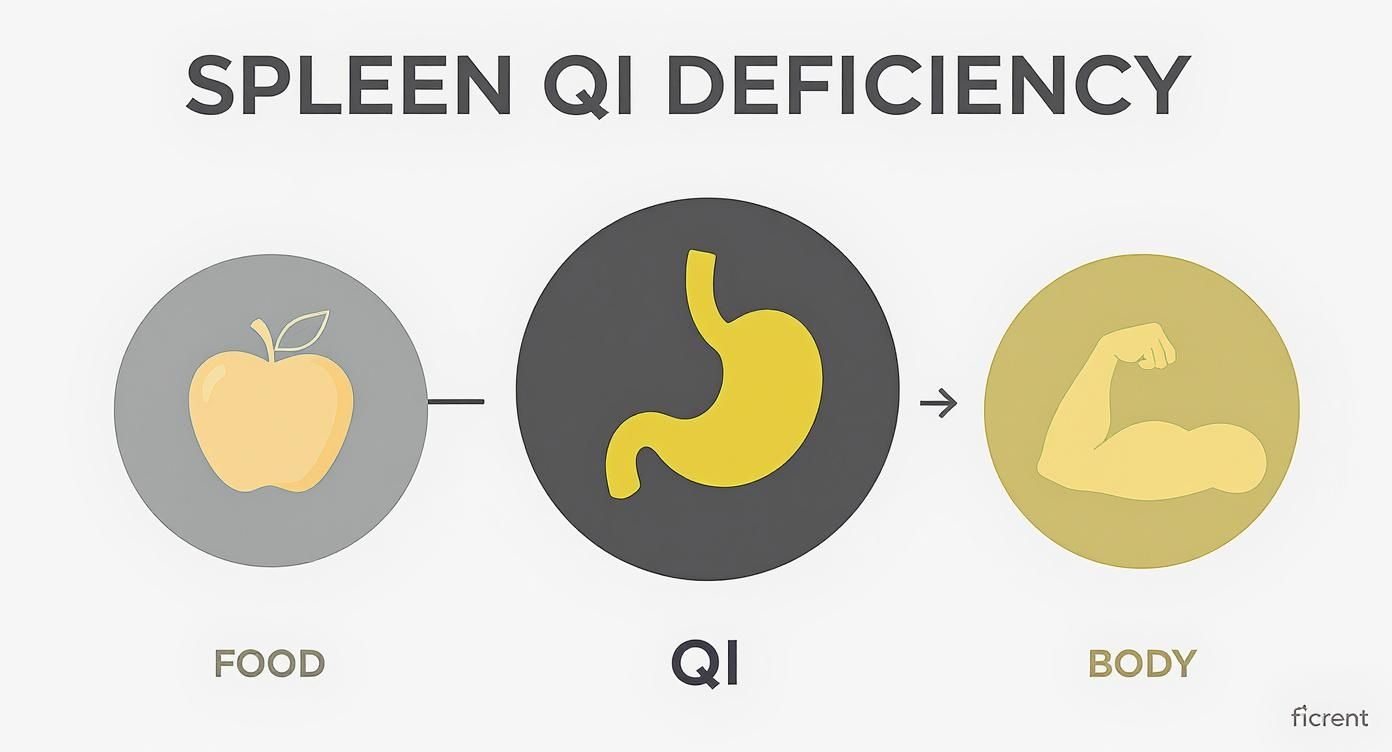
The graphic makes it clear: when the Spleen's function is compromised, your body's ability to generate energy and maintain its strength is directly hit.
In essence, Spleen Qi Deficiency isn't about a diseased organ. It’s about a functional weakness in your body's ability to create energy from nourishment. It’s the root cause behind feeling exhausted after a full night's sleep or getting bloated from a perfectly healthy meal.
Understanding this core idea is the first real step toward getting better. Rather than just chasing symptoms, the TCM approach focuses on repairing the engine itself. By strengthening the Spleen, we restore its power to generate abundant Qi, which naturally resolves the downstream issues of fatigue, digestive trouble, and mental fog.
To go a bit deeper, you can learn more about what Qi deficiency is and see how it can show up in different ways. This foundational knowledge paves the way for the targeted, practical solutions we’ll explore next.
Common Symptoms And Root Causes
Figuring out if you have Spleen Qi Deficiency often starts with noticing a pattern in how you feel day-to-day. Are you constantly exhausted, even after getting a solid eight hours of sleep? Do you feel bloated and heavy after meals, regardless of what you eat? These are the classic signs that your body’s digestive “pilot light” is burning low.
When the Spleen is weak, it struggles to do its main job: turning the food you eat into usable energy (Qi) and nutrients. This inefficiency sets off a chain reaction, with symptoms popping up that affect your digestion, your energy, and even your mood. Learning to spot these signs is the first step toward getting things back on track.
Digestive Distress Signals
The most obvious clues of a weak Spleen show up in the gut. Since this is the Spleen’s home base, digestive issues are usually the first—and loudest—complaints.
Think of it like trying to cook a meal over a weak flame. Everything takes longer, nothing gets cooked through, and you're left with a mess. A deficient Spleen has the same problem with the food you eat.
Common digestive symptoms include:
- Bloating: That uncomfortable, distended feeling in your belly, especially after you’ve eaten.
- Poor Appetite: You’re just not that interested in food, or you feel full after only a few bites.
- Loose Stools: A clear sign of incomplete digestion, sometimes with undigested food visible, or a tendency toward diarrhea.
- Sugar Cravings: Your body isn't getting real energy from your meals, so it sends out an SOS for a quick, sugary fix.
These are all signals that your body isn’t properly extracting Qi from your diet, leaving you feeling under-fueled even when you’re eating plenty.
Pervasive Low Energy And Physical Weakness
When your body can’t make enough Qi, the result is a bone-deep fatigue that sleep just doesn't seem to touch. This isn't your typical "I'm tired" feeling; it's a profound exhaustion that points directly to a need for Spleen Qi deficiency treatment.
This energy deficit makes its way through your whole body. Your arms and legs might feel heavy and leaden, turning simple activities into a major effort. You might also notice that your complexion looks a bit pale or washed-out, as the Spleen's weakness impacts its role in building healthy Blood.
In TCM, the Spleen is tasked with nourishing the muscles. When Spleen Qi is low, the muscles are underfed, leading to that nagging weakness, fatigue, and a feeling of heaviness that’s so hard to shake.
The Mental And Emotional Toll
Spleen Qi Deficiency is more than just a physical problem—it has a real impact on your mental and emotional state. In Chinese Medicine, the Spleen is connected to our capacity for thought and is closely tied to the emotion of worry.
A weak Spleen can lead to a mind that feels foggy and unfocused. You might find yourself overthinking things, getting stuck in mental loops, and ruminating on the same worries without finding a solution. This cycle of worry only drains the Spleen further, creating a vicious cycle that can be tough to break.
Uncovering The Root Causes
So, what causes the Spleen to become weak in the first place? More often than not, the culprits are modern lifestyle habits that put a slow, steady strain on our digestive and energetic systems.
Pinpointing these triggers is the key to lasting relief. The most common ones we see are:
- Dietary Habits: Too many cold, raw, or "damp" foods (think dairy, sugar, and greasy stuff) can put out the digestive fire. Eating in a hurry or while you're stressed also keeps the Spleen from working properly.
- Chronic Stress and Overthinking: The mind-body connection is powerful. Constant mental strain and worry directly attack Spleen Qi, leading to a stressed-out digestive system.
- Irregular Routines: Skipping meals, eating at odd hours, and having an erratic sleep schedule all throw your body's natural rhythm out of whack, making the Spleen’s job much harder.
- Overwork: Simply pushing yourself too hard for too long—mentally or physically—without enough rest is one of the fastest ways to deplete your body's core energy reserves.
By connecting the dots between your symptoms and their underlying causes, you can start making smart, targeted changes to help your body heal and rebuild its vital energy from the ground up.
Bridging Ancient Wisdom and Modern Science
For thousands of years, Traditional Chinese Medicine (TCM) has used the diagnosis of Spleen Qi Deficiency to describe a very specific cluster of symptoms: persistent fatigue, digestive upset, and a kind of mental cloudiness. It's a concept rooted in ancient wisdom, so you might naturally wonder, "What does modern science have to say about this?"
The answer is actually quite exciting. A growing body of research is creating a solid bridge between the ancient TCM framework and contemporary biomedical understanding. Scientists are finding real, measurable biological links that correspond to what TCM practitioners have been observing for centuries.
This isn't about replacing an old system with a new one. Instead, it’s about using modern tools to validate the profound accuracy of this age-old diagnosis, giving even more confidence to a modern spleen qi deficiency treatment plan.
Finding the Biological Footprint
Modern research is revealing a significant overlap between the pattern of Spleen Qi Deficiency and specific Western medical diagnoses. Studies have shown strong correlations with conditions like irritable bowel syndrome (IBS), chronic fatigue syndrome (CFS), and functional dyspepsia.
This suggests that TCM isn't just describing symptoms, but a functional, underlying imbalance that can give rise to these modern ailments. Instead of seeing them as separate problems, we can see how a core weakness in the body’s energy production and digestive systems manifests in different ways.
The convergence of TCM patterns and biomedical diagnoses highlights a crucial point: Spleen Qi Deficiency is not just a collection of symptoms, but a recognizable physiological state that modern science is beginning to map and understand.
Mapping the Mechanisms with Modern Tech
One of the most fascinating areas of research is a field called network pharmacology. Think of it as a high-tech mapping tool. It uses computational analysis to see exactly how the complex compounds in Chinese herbal formulas interact with genes, proteins, and biological pathways in the body.
For the first time, we can visualize how an ancient remedy travels through the body to restore balance on a molecular level.
For example, sophisticated analyses are now connecting the dots. Research on patients with conditions like chronic gastritis and IBS (often linked to Spleen Qi Deficiency) has pinpointed specific disruptions in the body's immune response and oxidative stress pathways.
Then, using these same computational methods, scientists can see that key herbs like Radix Astragali (Huang Qi) directly target these exact biomolecular networks. This provides a clear, scientific explanation for why these herbs work so well. To dive deeper into this fascinating connection, you can learn more about the science behind these findings.
So what does this all mean for you? It means that when a practitioner recommends a specific herbal formula, that guidance isn't just based on thousands of years of clinical experience—it's also supported by emerging scientific validation.
This research does more than just confirm what TCM has known all along. It builds confidence and shows that the principles of treating Spleen Qi Deficiency are grounded in an observable, biological reality. The ancient wisdom of TCM and the rigorous inquiry of modern science are finally beginning to speak the same language, offering a more complete and powerful path toward restoring your energy and well-being.
Herbal Medicine And Diet For Spleen Qi
When your digestive engine is running low, two of the most powerful tools we have are Chinese herbal medicine and what's on your plate every day. Think of herbs as the specialized repair crew that gets the engine running again, while your diet is the high-quality fuel that keeps it humming. Together, they form the bedrock for rebuilding your energy from the inside out.
Chinese herbal medicine isn't about just one "magic" herb. It's a highly refined practice of combining ingredients into balanced, elegant formulas where each herb has a specific job. This synergistic approach makes for a treatment that is both incredibly effective and gentle on your system.
Foundational Herbal Formulas For Spleen Qi
One of the most classic and trusted formulas for this pattern is Si Jun Zi Tang, or the "Four Gentlemen Decoction." For centuries, it has been the cornerstone formula for tonifying Spleen Qi. Its beautiful simplicity makes it the perfect starting point for countless personalized treatments.
The four "gentlemen" in this formula are:
- Ren Shen (Ginseng): A powerhouse Qi tonic that directly strengthens the Spleen and gives your whole system an energy boost.
- Bai Zhu (Atractylodes): Works hand-in-glove with Ginseng to fortify the Spleen. It also helps dry "dampness"—that heavy, bloated feeling that comes from poor digestion.
- Fu Ling (Poria): Gently helps the body drain away that dampness through urination while also supporting the Spleen's main job.
- Zhi Gan Cao (Honey-Fried Licorice): The great harmonizer. It brings all the other herbs together and adds its own gentle lift to your body's energy.
A licensed herbalist rarely prescribes a classic formula without a few tweaks. Your unique symptoms—like feeling particularly cold, having more bloating, or a very low appetite—will guide them to add or subtract specific herbs. This creates a remedy that’s perfectly matched to what your body needs right now.
This level of personalization is what makes the medicine so effective. While Si Jun Zi Tang is a fantastic base, someone whose fatigue comes with a "sinking" or heavy feeling might do better with Bu Zhong Yi Qi Tang ("Tonify the Middle and Augment the Qi Decoction"). To get a better sense of how these complex remedies are built, you can explore our guide on traditional Chinese herbal formulas.
Modern research is also beginning to validate what practitioners have known for centuries. A two-year, multicenter, randomized, double-blind study recently evaluated a new dietary TCM formula for spleen qi deficiency. The researchers used a specific Spleen Qi Deficiency grading scale to track improvements, showcasing the rigorous methods now being applied to confirm the efficacy of these ancient remedies.
Eating To Nourish Your Digestive Fire
Alongside herbal medicine, your daily diet is your best long-term strategy for keeping your Spleen happy. In Chinese medicine, food is medicine. The whole idea is to choose foods that are warming, nourishing, and easy for your already-weakened digestive system to handle.
Picture this: your Spleen would much rather have a warm, cooked meal than a cold, raw salad. Cold and raw foods force your body to expend precious energy just to warm them up for digestion—energy you simply don't have to spare when your Qi is already low.
Spleen-Friendly Foods To Embrace
Here are the kinds of foods that act like a direct deposit into your energy bank account:
- Well-Cooked Grains: Think of warm rice porridge (congee), oatmeal, millet, and quinoa. Cooking them thoroughly essentially pre-digests them, making them incredibly easy for your Spleen to transform into Qi.
- Roasted Root Vegetables: Sweet potatoes, carrots, parsnips, and squash have a naturally sweet flavor which, in TCM, directly nourishes the Spleen. Roasting adds warmth and makes them even easier to break down.
- Warming Spices: Ginger, cinnamon, black pepper, and fennel are fantastic for stoking that digestive fire. Don't be shy about adding them to your cooking.
- Quality Proteins: Small amounts of well-cooked meats like chicken, beef, or lamb—especially when made into soups and stews—can be deeply replenishing. Bone broth is particularly healing.
Maximizing nutrient absorption is crucial for building Qi, and understanding food combining principles can give your Spleen's digestive efficiency an extra edge.
Foods To Limit Or Avoid
Knowing what not to eat is just as important. Certain foods can put out the Spleen's "pilot light" and create more dampness, making your symptoms worse.
Try to cut back on these:
- Cold and Raw Foods: This means iced drinks, smoothies, big salads, and raw fruit. They all force your digestive system to work overtime.
- Dairy Products: In TCM, things like milk, cheese, and yogurt are known to be very "damp-producing." They often contribute to that feeling of bloating, loose stools, and brain fog.
- Sugar and Processed Foods: These give you a quick, empty energy spike but ultimately weaken the Spleen in the long run and feed more cravings.
- Greasy or Fried Foods: These are heavy and incredibly difficult to digest, completely overburdening an already taxed system.
By mindfully choosing warming, nourishing foods and using skillfully prescribed herbal formulas, you give your body the exact resources it needs to repair its engine and start producing abundant, sustainable energy again.
Using Acupuncture To Restore Your Energy
While herbs and food work from the inside out, acupuncture gives us a way to communicate directly with your body’s energy system. Think of it as a skilled technician making precise adjustments to your internal engine, using specific points to reboot and strengthen the Spleen’s essential functions.
This approach provides a direct and powerful spleen qi deficiency treatment by getting right to the source. It works by stimulating points along the meridians—the energetic pathways of the body—to tonify the Spleen, boost digestive power, and rebuild your foundational energy.
Key Acupuncture Points for Building Qi
Every treatment is tailored to the individual, but some acupuncture points are true powerhouses for fighting fatigue and strengthening digestion. Your acupuncturist will choose a combination that addresses your specific pattern of symptoms.
Here are a few of the most commonly used points:
- Stomach 36 (Zusanli): Found on the lower leg, this is arguably the most famous point for building energy. Its name, "Leg Three Miles," hints at its ability to give you the strength to walk another three miles, even when you feel completely spent.
- Spleen 6 (Sanyinjiao): This point is a critical meeting place for the Spleen, Liver, and Kidney meridians. By stimulating it, we can nourish all three organ systems, making it vital for building Blood and supporting overall vitality.
- Conception Vessel 12 (Zhongwan): Located on the abdomen, this is the Stomach's "Front-Mu" point. It has a direct line to the digestive organs, helping to calm bloating, improve appetite, and enhance the Spleen's ability to turn food into Qi.
These points are just a few examples of how we can target the root of your fatigue. For a closer look at how this therapy can help with gut-related issues, you can learn more about acupuncture for digestive issues and its wide-ranging benefits.
An acupuncture treatment for Spleen Qi deficiency does more than just chase symptoms. It fundamentally retrains your body to produce and circulate energy more efficiently, creating lasting resilience from within.
Complementary Therapies for Deeper Healing
To enhance the effects of an acupuncture treatment, we often incorporate complementary therapies. These techniques work in harmony with the needles to amplify the healing process, especially when cold is weakening the digestive fire.
One of the most valuable additions is moxibustion. This involves gently warming specific acupuncture points with a burning herb called mugwort (Artemisia vulgaris). The penetrating heat warms the meridians, invigorates Qi flow, and provides a deeply nourishing feeling to your core. Moxa over points on the abdomen or lower back feels like a warm, comforting hug for your entire digestive system.
Another powerful therapy is Tui Na, a form of Chinese medical massage. Using specific hand techniques along the meridians, we can break up stagnation and encourage the smooth flow of Qi and Blood, giving the Spleen the support it needs to function properly.
Combining these methods creates a multi-layered and robust approach. The needles provide precise stimulation, moxibustion adds warmth and vitality, and Tui Na ensures everything is moving freely. It’s a holistic strategy for rebuilding your energy from the ground up.
Lifestyle Habits That Support Spleen Health

While acupuncture and herbs are fantastic for getting you back on track, true, lasting recovery from Spleen Qi Deficiency really locks in when your daily habits support your healing. The small choices we make every day are what build a solid foundation for long-term health. These self-care practices are a critical part of a complete spleen qi deficiency treatment.
Often, the biggest shift comes not from what you eat, but how you eat. The Spleen is a creature of habit; it loves regularity and calm. Simply eating your meals at roughly the same time each day can do wonders for regulating your digestion, allowing it to work more efficiently.
Mindful eating is another non-negotiable. Try to avoid eating while you're working, staring at your phone, or watching TV. These distractions divert energy away from your digestive system, forcing an already tired Spleen to struggle for resources. Make it a practice to sit down, chew your food well, and actually pay attention to the meal in front of you.
Gentle Movement to Build Qi
When you’re feeling drained, the last thing you should do is force yourself through a punishing workout. That kind of intense exercise can actually deplete your Qi even further. For Spleen health, gentle, restorative movement is the name of the game. The goal is to get Qi moving, not burn it out.
Here are a few Spleen-friendly options to consider:
- Mindful Walking: A slow, relaxed walk, especially after a meal, is a classic way to support digestion without creating more strain.
- Tai Chi or Qigong: These ancient practices are perfect for rebuilding energy. They’re specifically designed to cultivate and circulate Qi through slow, intentional movements and coordinated deep breathing, which calms the mind and nourishes the whole body.
In the world of Chinese medicine, it's understood that worry and overthinking are the emotions that directly wear down the Spleen. Think of chronic mental churn as a slow, steady leak in your digestive energy tank—it makes it incredibly hard to refill your reserves, no matter how perfectly you eat.
Managing the Mind-Body Connection
To truly support your Spleen, you have to address the mental habits that weaken it. Breaking the cycle of worry is key, and simple mindfulness techniques can make a huge difference. You could start by setting aside just five minutes a day for quiet breathing. Just sit and focus on the feeling of your breath, without any pressure to change it.
This simple act helps settle your nervous system, giving your Spleen a much-needed break from the energetic drain of overthinking. By weaving these mindful habits into your daily life—around your meals, movement, and mental rest—you become an active partner in your own healing. Everyday routines can become powerful moments of self-care.
When To Seek Professional Guidance
https://www.youtube.com/embed/oJSpQHcJfKs
Making smart changes to your diet and lifestyle is a fantastic start for addressing Spleen Qi deficiency. It puts you in the driver's seat. But what if you've been eating all the right foods and still feel exhausted and bloated?
If your symptoms are severe, don't seem to be getting better after a few weeks, or are genuinely getting in the way of your life, it’s a clear signal to get professional guidance. Self-care is a crucial piece of the puzzle, but it can't take the place of an accurate, expert diagnosis.
Working with a licensed practitioner is key because it ensures you’re targeting the real root of the problem. What feels like a straightforward case of Spleen Qi Deficiency can often be tangled up with other patterns, like Dampness or Qi Stagnation. A professional can see these nuances and craft a plan that addresses your specific situation for more effective, lasting results.
Your Personalized Path To Recovery
Here at Eric Tsai Acupuncture & Herbs, your path to feeling better starts with a deep dive into your unique health landscape. We don't do cookie-cutter treatments. Instead, we use time-tested diagnostic methods to get a complete picture of what's happening inside your body.
Our detailed evaluation is a three-part process:
- Tongue Diagnosis: The color, shape, and coating on your tongue offer an incredible window into your internal health, revealing the status of your digestive system and overall Qi.
- Pulse Analysis: By carefully feeling the different qualities of the pulse at your wrist, we can gauge the strength and balance of Qi within your major organ systems.
- In-Depth Health History: We'll sit down and talk. We'll discuss your symptoms, daily habits, diet, and even your emotional state to connect the dots and pinpoint the root cause of the imbalance.
This thorough approach takes the guesswork out of the equation, allowing us to build a treatment plan that's made just for you.
A TCM diagnosis is like creating a personalized blueprint for your health. It reveals not just what is imbalanced, but why—and that is the key to creating lasting change and restoring your body's natural vitality.
Using this blueprint, we'll integrate powerful therapies like acupuncture and custom-blended herbal formulas to rebuild your Spleen Qi from the ground up. Beyond in-clinic treatments, creating a supportive environment at home is essential for long-term wellness. Many people find that adopting healthier habits for your family can make a huge difference, ensuring every aspect of your life supports your goal of renewed energy.
Ready to stop feeling tired and bloated? At Eric Tsai Acupuncture and Herbs, we combine ancient wisdom with a modern understanding of health to create a personalized treatment plan just for you. Take the first step toward restoring your energy and schedule your consultation today at https://drerictsai.com.