
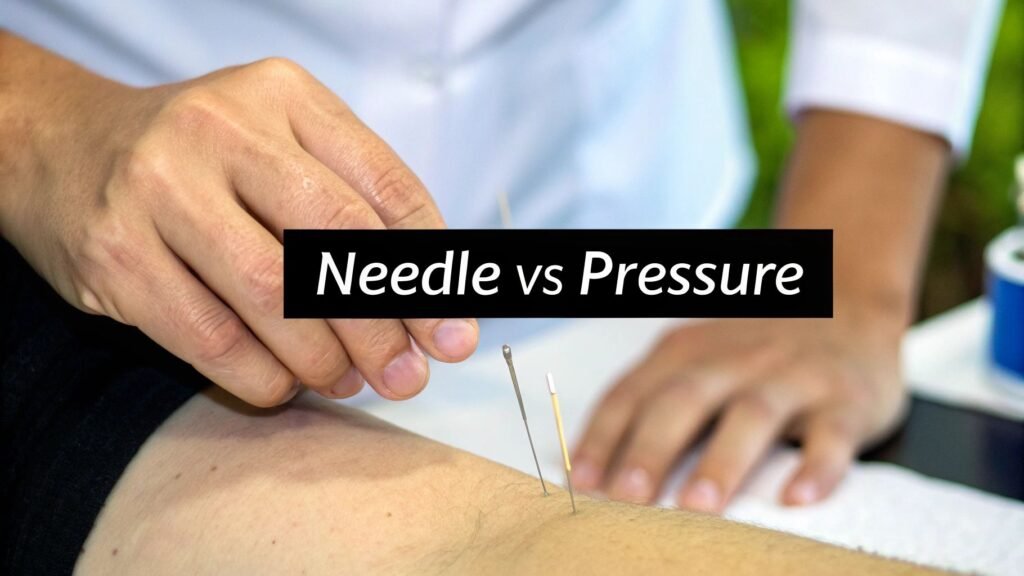
At its heart, the difference between acupuncture and acupressure comes down to the tool used for stimulation. Acupuncture involves fine, sterile needles that pierce the skin to reach specific points, while acupressure relies on firm, non-invasive physical pressure from hands, elbows, or special tools on those same spots.
Both therapies are rooted in Traditional Chinese Medicine (TCM) and share the goal of balancing the body's energy flow, or qi. However, their methods and the sensations they produce are worlds apart.
A Deeper Look at the Core Difference
While acupuncture and acupressure share a common map of the body's energy pathways, their distinct approaches lead to very different experiences. One is a clinical procedure that must be performed by a licensed professional; the other is a hands-on therapy that can even be practiced as a form of self-care.
Getting a handle on this key difference is the first step in figuring out which therapy might be a better fit for your health goals.

Comparing the Foundational Methods
To truly understand how these two practices diverge, it helps to put their core attributes side-by-side. The choice of tool—a needle versus a hand—shapes everything from the practitioner's required training to what you'll feel during a session.
Here’s a quick summary of the primary distinctions between the two therapies.
Acupuncture vs Acupressure At a Glance
| Attribute | Acupuncture | Acupressure |
|---|---|---|
| Tool | Thin, sterile, single-use needles | Fingers, thumbs, elbows, or specialized blunt tools |
| Invasiveness | Minimally invasive; needles penetrate the skin | Non-invasive; pressure is applied to the skin's surface |
| Practitioner | Must be a licensed acupuncturist (L.Ac.) with extensive training | Can be a massage therapist, other bodyworkers, or self-administered |
| Sensation | A slight pinch, followed by tingling, warmth, or a dull ache | Deep, firm pressure that can be adjusted for comfort |
| Goal | Precise stimulation of deep nerves and connective tissues | Broader stimulation of surface-level nerves and muscles |
This table makes it clear that while both therapies target the same acupoints, the precision and depth are vastly different. Your choice often hinges on the specific condition you're trying to address and your personal comfort with needles.
It's also worth noting that many bodywork therapies have unique characteristics. For a look at how other modalities compare, you might find resources like this one helpful: What Is The Difference Between Myotherapy and Remedial Massage?
Professional Recognition and Economic Impact
Acupuncture, in particular, has earned significant recognition in Western medicine over the past few decades. The National Institutes of Health recommended its inclusion in medical school curricula back in 1997, cementing its place as a credible complementary therapy.
The economic benefits are also well-documented. Studies have shown that inpatient acupuncture can reduce hospital stay costs by 14% for matched patient groups. In certain Medicaid pilot programs, it has even been shown to lower average care costs by 27%.
The crucial takeaway is that acupuncture offers targeted, deep stimulation ideal for complex or chronic conditions, whereas acupressure provides a broader, more accessible approach for general wellness and mild symptom relief.
With this foundational understanding in place, we can now explore the shared philosophical roots of both practices in Traditional Chinese Medicine.
Understanding Their Shared Philosophical Roots
To really get a handle on what separates acupuncture and acupressure, we first need to look at what they have in common. Both are branches of the same ancient tree: Traditional Chinese Medicine (TCM), a healing system that’s been honed for thousands of years. Their common goal isn't just chasing symptoms—it's about guiding the body back to its natural state of balance.
At the very heart of this philosophy is the concept of Qi (pronounced "chee"). This is often translated as "vital life force" or "energy." In TCM, Qi is the spark that animates us, flowing through every living thing to do everything from regulate our temperature to fight off a cold. When your Qi is full and flowing freely, you feel healthy and vibrant.
The Body’s Energy Superhighway
This vital energy isn't just floating around aimlessly. It travels along specific pathways called meridians. You can think of these meridians as a complex highway system or an invisible circulatory network that connects every part of your body. There are 12 major meridians, each tied to a specific organ system, all woven together in a continuous web.
These pathways make sure Qi gets to every muscle, organ, and cell. When there's a blockage or imbalance—like a traffic jam on the highway—it's seen as the root cause of pain, illness, or even emotional distress.
The core idea behind both acupuncture and acupressure is simple: clear these energy blockages, and you allow the body to tap into its own powerful, innate ability to heal itself.
Acupoints: The Gateways to Healing
Dotted along these meridians are specific locations known as acupoints. There are hundreds of them, and each one acts as a precise access point to influence the flow of Qi in its meridian. These are the exact spots that both an acupuncturist’s needle and an acupressurist’s fingers will target.
Stimulating an acupoint can achieve several things:
- Release blockages and get Qi flowing smoothly again.
- Redirect energy from an area with too much to one that's deficient.
- Strengthen the energy of a particular organ system.
- Calm the nervous system and prompt the release of endorphins—the body's natural painkillers.
Take, for example, the well-known acupoint LI4 (Hegu), found in the webbing between the thumb and index finger. Stimulating this point is famous for relieving headaches and facial pain. Both therapies work on this same point; the only difference is the tool they use to do it—a fine needle versus firm pressure. You can dive deeper into this fascinating concept by reading about what is Qi in Chinese medicine.
Ultimately, both disciplines spring from this shared map of the body's energetic landscape. They are simply two different keys designed to unlock the same door, each with a unique way of turning the lock to restore balance and well-being. Understanding this common ground is the key to appreciating what makes them different.
Comparing The Treatment Experience And Methodology
When you walk into a treatment room for acupuncture versus acupressure, the experience is worlds apart, even though both therapies target the same points on the body. It’s not just about needles versus hands; the entire process—from the practitioner's credentials to the atmosphere in the room—is fundamentally different.
Acupuncture is, first and foremost, a clinical procedure. It can only be performed by a licensed acupuncturist (L.Ac.), a professional who has completed thousands of hours of specialized education and passed rigorous board exams. This training ensures they have a mastery of anatomy, clean needle techniques, and the complex diagnostics of Traditional Chinese Medicine.
Acupressure, on the other hand, is far more accessible. While you can receive it from a trained massage therapist, it’s also a powerful self-care technique anyone can learn. This makes it an excellent tool for managing minor aches and pains right from your own home.

A Look Inside An Acupuncture Session
Your first acupuncture appointment will start with a thorough conversation. The practitioner will ask about your health history, daily habits, and symptoms, and they’ll likely perform traditional diagnostics like looking at your tongue and feeling your wrist pulses. This is all part of building a holistic picture to create a treatment plan just for you.
Once the plan is set, you’ll get comfortable on a treatment table. The acupuncturist will then insert several sterile, hair-thin needles into specific points. Most people feel a tiny pinch or a dull, heavy sensation called deqi—a sign that the point is activated and the body's energy is responding.
The needles usually stay in for about 20 to 45 minutes while you relax in a quiet room. It's an incredibly calming experience, and many patients even drift off to sleep. This peaceful state allows your nervous system to shift into its "rest and repair" mode. If you're curious about the specifics, you can learn more about what to expect from an acupuncture session.
What An Acupressure Session Feels Like
An acupressure session feels more like a highly targeted form of massage. You’ll typically remain fully clothed, either lying on a table or sitting in a chair. The practitioner will use their fingers, thumbs, or even elbows to apply firm, steady pressure to the acupoints.
The pressure is adjusted to your comfort level—it should feel deep and effective, but never painful. The therapist works systematically, holding each point for a few seconds to several minutes to release blockages and get energy moving freely again.
The core difference comes down to precision versus breadth. Acupuncture provides incredibly targeted, deep stimulation to nerves and tissues. Acupressure offers a broader, more generalized relief to the surrounding muscles and energy pathways.
Comparative Analysis of Treatment Protocols
To really understand the differences, it helps to see the procedural and regulatory aspects side-by-side. This table breaks down what you can expect from a typical session for each therapy.
| Aspect | Acupuncture | Acupressure |
|---|---|---|
| Practitioner | Must be a Licensed Acupuncturist (L.Ac.) with board certification. | Can be a massage therapist, bodyworker, or self-administered after learning. |
| Environment | A clinical, quiet, and private setting is standard. | Varies widely from a clinic or spa to the comfort of your own home. |
| Patient Role | Passive. You simply rest and relax while the needles do their work. | Can be passive or active, often providing feedback on pressure levels. |
| Session Length | Typically 45-60 minutes, including consultation and rest period. | Ranges from 30-60 minutes, with self-care sessions being much shorter. |
| Tools Used | Sterile, single-use needles of various lengths and gauges. | The practitioner’s hands, thumbs, elbows, or simple, blunt tools. |
As you can see, the formal, regulated nature of acupuncture contrasts sharply with the accessible, hands-on approach of acupressure, each offering a distinct path toward wellness.
Which Conditions Does Each Therapy Treat Best?
While both acupuncture and acupressure are built on the same principles of the body's energy map, they aren't interchangeable. The way they stimulate acupoints—one with fine needles, the other with firm pressure—makes each therapy better suited for different health concerns. It really boils down to the nature of your condition. Are you dealing with a deep-seated, chronic issue, or is it a more surface-level problem that responds well to broader touch?
The key distinction is the depth of stimulation. Acupuncture's needles can precisely access nerves and connective tissues deep within the body, making it a powerful tool for complex health puzzles. Acupressure, on the other hand, is gentler and far more accessible, perfect for managing general wellness and milder symptoms.

Acupuncture's Strengths in Chronic and Complex Conditions
Acupuncture truly comes into its own when we're up against stubborn, chronic conditions rooted deep in the body's systems. The precise, targeted stimulation from a needle can trigger significant physiological changes, which is why it’s often the therapy people turn to when other treatments haven't delivered results.
It’s particularly well-known for its effectiveness in managing pain. This is because the needles can directly stimulate nerves that signal the brain to release endorphins and encephalin—our body’s own powerful, natural pain relievers.
Acupuncture often excels in these areas:
- Chronic Pain Management: This is where the research is strongest. It's a proven therapy for low back pain, osteoarthritis, and fibromyalgia, thanks to its ability to reduce inflammation and modulate how the brain perceives pain signals.
- Migraines and Headaches: By targeting specific points on the head, neck, and even hands, an acupuncturist can help reduce both the frequency and severity of debilitating migraines.
- Neurological Conditions: It's frequently used to help manage symptoms tied to conditions like sciatica or Bell's palsy by directly stimulating the affected nerve pathways.
- Infertility and Women's Health: Many turn to acupuncture to help regulate menstrual cycles, improve blood flow to reproductive organs, and support the body during fertility treatments.
Think of someone who has struggled with chronic low back pain for years. They’ve tried physical therapy and medication with only temporary success. For them, acupuncture offers a new approach. The practitioner can insert needles to reach deep muscle trigger points and nerve roots that broader therapies simply can't touch, opening up a new pathway to genuine relief.
Acupressure's Role in Stress Relief and Self-Care
Acupressure is the clear winner when it comes to accessibility and immediate, gentle relief. Since it's completely non-invasive, it serves as a fantastic introduction to Traditional Chinese Medicine. More importantly, it's a powerful self-care tool you can use anytime, anywhere.
Its benefits are most pronounced for conditions related to stress, tension, and mild discomfort. Applying firm pressure to specific acupoints helps release muscle knots, improve local blood flow, and gently calm the nervous system.
Acupressure empowers you to take an active role in your own wellness. It's a practical skill for managing everyday stressors and symptoms, providing a sense of control over your health that can be incredibly therapeutic in itself.
Acupressure is commonly recommended for:
- Nausea and Motion Sickness: The Pericardium 6 (P6) point on the inner wrist is famous for its ability to quell nausea, whether from morning sickness, chemotherapy, or post-operative recovery.
- Stress and Anxiety Relief: Gently pressing points like the "Third Eye" point between the eyebrows can have an immediate, noticeable calming effect. We have a whole guide on using acupressure points for anxiety if you want to learn more.
- Insomnia and Sleep Issues: Certain points are known to help relax the body and quiet the mind, making it easier to drift off to sleep.
- Headaches and Minor Aches: For a tension headache or sore muscles, a little self-administered acupressure can provide quick, on-the-spot relief.
Scientific interest in acupressure has exploded. Between 2004 and 2024, researchers identified 770 publications on the topic, and an incredible 45% of those were published in just the last four years. This research often focuses on areas like insomnia, labor complications, and stress—a different focus than acupuncture's emphasis on chronic pain. You can read the full research about these findings to dive deeper into its expanding applications.
Imagine a patient recovering from surgery who is struggling with nausea. A nurse could show them how to apply steady pressure to the P6 point on their wrist. This simple, non-invasive technique can provide significant relief without medication and, crucially, gives the patient a tool to manage their own symptoms. It’s a perfect example of acupressure's practical, immediate benefits.
Navigating Safety Risks and Professional Standards
When you're weighing acupuncture against acupressure, it's smart to look closely at the safety side of things and the standards that govern each practice. Both are considered very safe, but their risk profiles are quite different—one involves needles, and the other doesn't. Understanding this is the first step to making a confident choice.
Acupuncture naturally comes with more inherent risk simply because it breaks the skin. This makes one factor absolutely critical: your treatment must be done by a licensed acupuncturist (L.Ac.). These practitioners go through thousands of hours of rigorous training in anatomy, clean needle technique, and Traditional Chinese Medicine diagnostics, all of which are designed to keep you safe.
When a qualified professional uses sterile, single-use needles, acupuncture is incredibly safe. Most side effects are minor and pass quickly. You might see:
- A tiny bit of bleeding or a small bruise where a needle went in.
- A feeling of mild soreness or a dull ache during or after your session.
- A sense of deep relaxation, or in some cases, a little lightheadedness.
Serious problems, like an infection or organ injury, are extremely rare. When they do happen, it's almost always tied to someone who isn't properly trained or isn't using sterile needles.
The Gentle Safety Profile of Acupressure
Acupressure, on the other hand, boasts an exceptionally high safety profile. Because it's completely non-invasive, the risk of infection or injury is practically zero. This makes it a fantastic tool for self-care at home. Its accessibility is a huge plus, but that same ease of access means the practice is largely unregulated.
While it’s safe for almost anyone, there are a few important exceptions to be aware of. You'll want to avoid applying firm pressure in certain scenarios.
Acupressure's safety lies in its non-invasive nature, making it ideal for self-treatment. However, this accessibility means users must be mindful of contraindications, especially when applying pressure to sensitive areas or during pregnancy.
Specifically, it's best to steer clear of acupressure:
- Directly on open wounds, varicose veins, tumors, or inflamed skin.
- On specific acupoints during pregnancy, as a few are traditionally thought to induce labor.
- If you have a serious heart condition or a bleeding disorder—it's always best to check with your doctor first.
The scientific community's interest in acupuncture has solidified its place in modern healthcare. A look at global research from 2013 to 2022 reveals a steady rise in studies, with the UK, China, and Germany joining the US as key research hubs. Journals like Medicine (USA) published 479 articles (10.52%), and Acupuncture in Medicine (UK) contributed 300 (6.59%), highlighting the ongoing effort to validate the therapy. You can dig deeper into these global acupuncture research trends.
In the end, safety for both therapies comes down to being diligent. For acupuncture, that means checking your practitioner's credentials. For acupressure, it means learning the right techniques and knowing when to hold back.
How to Choose the Right Therapy for Your Needs
Deciding between acupuncture and acupressure really boils down to your personal health goals, your comfort level with different techniques, and the specific condition you're hoping to address. The two therapies are distinct enough that by asking yourself a few key questions, the right path will usually become clear.
Start by thinking about what you want to achieve. Are you looking for relief from deep, chronic pain that just won't go away, or are you trying to manage daily stress and improve your general well-being? Also, consider the setting: do you prefer a treatment from a licensed professional, or is a self-care technique you can use anytime, anywhere more appealing? Your answers will guide your choice.
Evaluating Your Primary Goal
The biggest deciding factor is the nature of your health concern. If you're wrestling with a complex, persistent issue that hasn't responded well to other treatments, acupuncture is almost always the more powerful option. Its ability to deliver deep, precise stimulation makes it incredibly effective for chronic conditions.
On the other hand, if your goal is more about reducing stress, soothing a mild tension headache, or managing a bout of nausea, acupressure offers a gentle, non-invasive solution you can control yourself. It's an immediate tool you can have at your fingertips.
The decision often hinges on intensity and accessibility. Acupuncture is a targeted, clinical intervention for significant health issues, while acupressure is a versatile, accessible tool for maintaining balance and managing milder symptoms.
Your Comfort and Practical Needs
Don't underestimate personal preference. If you have a genuine fear of needles, the choice is simple—acupressure is the comfortable, effective alternative. But if you'd rather lie back and relax while an expert handles the entire process, acupuncture delivers that passive, therapeutic experience.
Your lifestyle is another key piece of the puzzle. Need a quick technique to calm your nerves before a big presentation? Acupressure is perfect for that. Are you looking for a structured, long-term treatment plan to support fertility? That's when you should seek out a licensed acupuncturist.
Both therapies fit beautifully into a wider holistic wellness approach, where the goal is to treat the whole person, not just a single symptom.
This decision tree can help you visualize whether to see a licensed professional or if a self-care approach is right for you.

As the infographic shows, any treatment involving invasive methods like acupuncture absolutely requires a licensed professional. Non-invasive therapies like acupressure, however, can be safely self-administered for general wellness.
Ultimately, by matching the therapy's strengths with your specific health objectives, you can confidently choose the path that best supports your well-being.
Frequently Asked Questions
When you start digging into the differences between acupuncture and acupressure, a lot of practical questions pop up. Getting clear answers can help you figure out which therapy fits your needs and feel good about your choice.
Can I Do Acupressure on Myself at Home?
Yes, you absolutely can, and that's one of the biggest advantages of acupressure. Since it doesn’t involve any needles, anyone can learn the basics to help with everyday issues like headaches, an upset stomach, or stress. You can find plenty of high-quality books, videos, and guides online to show you how to find the right points and apply pressure correctly and safely.
It's a fantastic way to play a more active role in your own health and get relief right when you need it.
Self-acupressure is great for managing minor symptoms and general well-being, but it isn't a replacement for professional care. If you're dealing with a serious or long-term health problem, always see a qualified healthcare provider.
Is Acupuncture Painful?
This is probably the most common question I hear. The truth is, acupuncture shouldn't hurt. The needles are sterile, used only once, and are incredibly fine—sometimes no thicker than a human hair.
Most people feel a slight pinch when the needle goes in, followed by a sensation of warmth, tingling, or a gentle, dull ache. This feeling, called deqi, is actually a good sign. It tells the practitioner that the acupoint has been properly stimulated.
How Do I Find a Good Practitioner?
Finding a skilled professional is essential, especially when it comes to acupuncture.
- For Acupuncture: Your best bet is to find a Licensed Acupuncturist (L.Ac.). This license guarantees they’ve gone through thousands of hours of rigorous training and passed national board exams on clean needle techniques, anatomy, and the principles of Traditional Chinese Medicine.
- For Acupressure: While the regulations aren't as strict, look for a certified massage therapist or bodywork specialist who has specific training in acupressure or a related practice like Shiatsu.
Always do your homework. Check their credentials, read patient reviews, and feel free to ask about their experience with your specific health concerns before you commit to a session.
Will I See Results Right Away?
It really depends. With acupressure, you might notice immediate relief from things like nausea or a tension headache. Its calming effect can often be felt within just a few minutes.
Acupuncture, on the other hand, tends to have a more cumulative effect, particularly for chronic issues. Some people feel a difference after their very first treatment, but it usually takes a series of sessions to achieve significant, lasting change. The idea is to gently guide your body back into balance over time, encouraging long-term healing.
At Eric Tsai Acupuncture and Herbs, our commitment is to help you discover the most effective route to better health. Dr. Tsai blends an in-depth knowledge of Traditional Chinese Medicine with a modern, science-informed perspective to develop a plan that works for you. If you’re curious about how acupuncture and herbal medicine can help you manage pain, ease stress, or regain balance, we encourage you to book a consultation.
Find out more and schedule your appointment at https://drerictsai.com.